Gauntlet Gallery
What is Shepard Fairey’s piece called “Giant Power To The Posse”?
Artist Statement
Screen Print 18 x 24 inches Edition of 100 I did a poster with Andre-as-Black-Power-guy holding up his fists and saying "Power to the Posse," though the original image I appropriated said "Kill Whitey." As I was printing the posters, I got the idea to leave the thought bubble blank and paste them up on the street as a pseudo-Rorschach test to see what people would write in them. I tried it out, and although I never saw anything particularly awesome written in it, it inspired me to hand the posters over to some of my artist friends—KAWS, TWIST, Andy Howell, Tommy Guerrero, and Aaron Rose—and give them carte blanche with it. It's always fun to find ways to create that sort of confluence of styles.
Summary
Giant Power To The Posse is a 1996 screen print published by Obey Giant, measuring 18 by 24 inches in a first edition of 100. It depicts Andre the Giant as a Black Power figure with raised fists and the slogan "Power to the Posse," reworking an appropriated source image. Fairey originally left the thought bubble blank, pasting copies on the street as a kind of public Rorschach test to see what passersby would write. He then handed prints to artist friends including KAWS, TWIST, Andy Howell, Tommy Guerrero, and Aaron Rose to alter freely. The result is a deliberately open, collaborative work blending OBEY iconography with street-art exchange.
Why It Matters
Giant Power To The Posse is one of the most conceptually rich early Fairey prints because the source preserves his own account of how it worked. Rather than a fixed image, Fairey designed it as a participatory object: by leaving the thought bubble blank and pasting copies in the street, he turned the print into a public Rorschach test, inviting strangers to complete the message. That gesture reflects the experimental, interactive spirit of mid-1990s street art and Fairey's interest in how an image circulates and is reinterpreted. The collaborative dimension deepens its importance: he gave prints to a notable group of peers including KAWS, TWIST, Andy Howell, Tommy Guerrero, and Aaron Rose, granting them carte blanche to remake the work. For collectors, that roster connects the piece to a wider network of influential street and skate artists, several of whom became major names. The work also engages directly with appropriation and provocation, since Fairey notes the original image he sampled carried a very different, charged slogan that he transformed. This layering of public participation, peer collaboration, and pointed source material makes it stand out among his early editions as a document of community and process rather than a static graphic.
Collector Perspective
This print draws collectors interested in collaboration and the broader street-art community, given Fairey's handoff to KAWS, TWIST, Andy Howell, Tommy Guerrero, and Aaron Rose. Those associations make it appealing to buyers who collect across the skate and graffiti lineage, not just OBEY. The participatory thought-bubble concept gives it a strong story for display, and the raised-fist Andre composition is graphically bold. With a first edition of 100, it is a focused early piece that anchors a mid-1990s grouping. Collectors who value process, provenance, and the intersection of multiple artists will find this more compelling than a straightforward portrait print.
Historical Context
Dated 1996, Giant Power To The Posse comes from the experimental mid-1990s period when Fairey was probing how the Andre the Giant icon could function as public, interactive art. His account of pasting blank-bubble copies on the street and inviting passersby to fill them in captures the era's emphasis on circulation and reinterpretation. Handing the work to peers like KAWS and TWIST situates it within the collaborative skate-and-graffiti milieu that shaped Fairey's practice. The piece predates his polished propaganda style and political prints, and its sampling of a charged source slogan shows his early engagement with appropriation and provocation. Within his arc it marks a community-driven, process-focused moment distinct from his later studio output.
FAQ
What is the concept behind this print?
It shows Andre the Giant as a Black Power figure with raised fists and the slogan "Power to the Posse." Fairey originally left the thought bubble blank and pasted copies on the street as a pseudo-Rorschach test to see what people would write, then handed prints to artist friends to alter freely.
Which artists were involved?
Per Fairey's statement, he gave the posters to KAWS, TWIST, Andy Howell, Tommy Guerrero, and Aaron Rose with carte blanche to rework them. He describes enjoying that confluence of styles, making the piece a collaborative exchange across the street and skate art community.
What was the original source image?
Fairey notes the image he appropriated originally carried the slogan "Kill Whitey," which he transformed into "Power to the Posse." This reflects his early engagement with provocative appropriation and the reworking of charged source material into his own iconography.
What are the edition size and dimensions?
The source lists a first edition of 100, screen printed at 18 by 24 inches, published by Obey Giant in 1996. The source does not state it is sold out, so availability beyond the edition size is not claimed.
Related Works
About the Artist
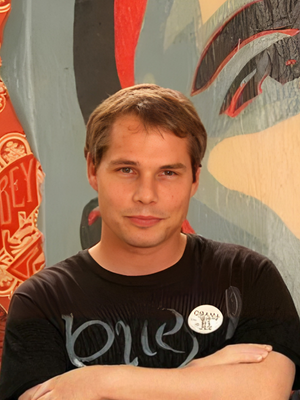
Shepard Fairey (b. 1970, Charleston, South Carolina) is an American street artist, graphic designer, and activist, and a graduate of the Rhode Island School of Design. His 1989 “André the Giant Has a Posse” sticker grew into the global OBEY GIANT campaign — an ongoing experiment in propaganda, obedience, and visual culture. He reached worldwide recognition with the 2008 “Hope” portrait of Barack Obama, now held by the Smithsonian National Portrait Gallery. Across screen prints, stencils, murals, and collage, Fairey channels propaganda aesthetics toward themes of peace, justice, environmentalism, and civil rights. His work is in the collections of the Museum of Modern Art, the Victoria & Albert Museum, and LACMA.