Gauntlet Gallery
What is Shepard Fairey’s piece called “Black On Black”?
Artist Statement
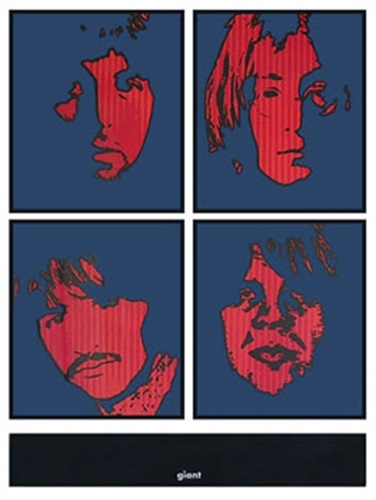
This print is sometimes known as "Giant Red and Navy" and was the first print produced by Shepard Fairey after he moved from Providence to San Diego.
Summary
Black On Black is a 1996 screen print published by Obey Giant, measuring 25 by 19 inches, with no edition size listed in the source. It is sometimes known as "Giant Red and Navy" and is significant as the first print Shepard Fairey produced after relocating from Providence to San Diego. The source provides only this brief context, so details about its specific imagery and message are limited. Its importance rests largely on this biographical marker: it documents the start of Fairey's San Diego chapter within his early OBEY work. The entry is written cautiously given the sparse source description.
Why It Matters
Black On Black carries a specific biographical significance that elevates it above a routine early edition: the source identifies it as the first print Fairey produced after moving from Providence to San Diego. That makes it a documented turning point in his geography and career, marking the start of the San Diego chapter that shaped his subsequent output. For collectors who organize Fairey's work around life milestones, this kind of first-after-a-move artifact has clear narrative value beyond its visual content. The alternate name "Giant Red and Navy" hints at a color-driven composition within his Giant iconography, though the source does not describe the imagery in detail, so claims about its message should stay modest. The absence of a listed edition size means its scarcity cannot be fixed from the source, and rarity should not be assumed. What the record reliably supports is its status as a transitional early work, bridging his East Coast origins and the West Coast base where the OBEY project matured. Within the 1996 cluster of early Giant prints, it stands out specifically for this relocation marker rather than for documented thematic ambition. Collectors of provenance and career chronology are its natural audience, valuing it as a primary-source signpost in Fairey's geographic and artistic trajectory.
Collector Perspective
This print appeals to collectors focused on biography and career milestones, since the source frames it as Fairey's first print after moving from Providence to San Diego. That transitional status gives it a clear story for anyone assembling a timeline of his development. The alternate name "Giant Red and Navy" suggests a color-forward Giant composition with display appeal. With no edition size listed, scarcity is unknown, so the draw is narrative rather than confirmed rarity. It fits naturally into a focused early-period grouping alongside other 1996 Giant prints. Buyers who value documented provenance and turning points will find it more compelling than its sparse description alone might suggest.
Historical Context
Dated 1996, Black On Black marks a concrete transition in Fairey's arc: the source calls it the first print he made after relocating from Providence to San Diego. That move opened the West Coast chapter during which the OBEY project expanded, making this a signpost work rather than a generic early edition. It sits within the mid-1990s Giant period, sharing the iconography of his other prints from this window, but its specific value lies in the relocation marker. With limited description and no listed edition size, its place in the arc is defined more by biography than by documented theme. It predates his propaganda aesthetic and political work, anchoring the start of his San Diego years.
FAQ
Why is Black On Black significant?
According to the source, it is the first print Shepard Fairey produced after moving from Providence to San Diego. That makes it a documented turning point in his career and geography, marking the start of the San Diego chapter during which the OBEY project matured.
Is this print also known by another name?
Yes. The source notes it is sometimes known as "Giant Red and Navy," which suggests a color-driven composition within his Giant iconography. The source does not provide further description of the specific imagery beyond this alternate title.
How large is the edition?
The source does not list an edition size for this print, so its scarcity cannot be determined from the available information. No claim of rarity or sold-out status is made here, since the source does not support one.
What are its dimensions and medium?
It is a screen print measuring 25 by 19 inches, dated 1996 and published by Obey Giant. Beyond the relocation context and alternate name, the source offers limited detail about its concept.
Related Works



About the Artist

Shepard Fairey (b. 1970, Charleston, South Carolina) is an American street artist, graphic designer, and activist, and a graduate of the Rhode Island School of Design. His 1989 “André the Giant Has a Posse” sticker grew into the global OBEY GIANT campaign — an ongoing experiment in propaganda, obedience, and visual culture. He reached worldwide recognition with the 2008 “Hope” portrait of Barack Obama, now held by the Smithsonian National Portrait Gallery. Across screen prints, stencils, murals, and collage, Fairey channels propaganda aesthetics toward themes of peace, justice, environmentalism, and civil rights. His work is in the collections of the Museum of Modern Art, the Victoria & Albert Museum, and LACMA.