Gauntlet Gallery
What is Shepard Fairey’s piece called “Oil & Gas Building”?
Artist Statement
Industrial power has been a point of pride in America since the early 20th century, and many impressively iconic, if monolithic, architectural landmarks have been erected as symbols of industrial dominance. The Chrysler building, the General Electric building, and the Sears Tower come to mind. Dominant industrial forces may build great monuments to their success, but those physical manifestations of their power and ego often correlate to the dangerously disproportionate influence they have on politics and policy. This Oil & Gas print is about the volatility of giving an industry with too much power the ability to manipulate politics in its favor despite the dangers to the environment and climate change. The situation is going to blow up in our faces metaphorically, and already has for too many people literally as well(remember the BP explosion and spill?). A lot of people freaked out that the Obama administration lost taxpayers about 600 million by investing in Solyndra, a solar panel company developing a new technology, which went bankrupt. However, few people seem upset that the U.S, govt. gives approximately 25 billion in tax breaks and subsidies to the highly profitable oil and gas industries. The Solyndra investment did not work out, but the need to fund new, renewable technologies, should be obvious when the rapidly depleting oil and gas sources become more difficult and dangerous to extract every passing day. The only reason the govt. subsidies are so disproportionate is because of the massive power the dying oil and gas industry still has. The Oil & Gas industry, which includes multinational and independent oil and gas producers and refiners, natural gas pipeline companies, gasoline service stations and fuel oil dealers, has long enjoyed a history of strong influence in Washington. Individuals and political action committees affiliated with oil and gas companies have donated $238.7 million to candidates and parties since the 1990 election cycle, 75 percent of which has gone to Republicans. Though oil is finite, our reliance on it is so extreme that the power wielded by those who control oil is virtually unlimited. Oil and gas companies and the car manufacturers who profit heavily from gas powered engines used their power and influence to overturn a zero emissions law in the state of California, effectively delaying electric cars arriving on the market accessibly for ten plus years. It is dangerous for an industry to have that much power. We need to cultivate renewable alternatives, and for the sake of the future, we need to push the govt. to support the developers of new technologies rather than subsidizing old fossil fuel models moving toward obsolescence . Thanks for caring -Shepard 18 x 24 inch screen print. Signed and numbered edition of 450. Limit 1 per person/household. $45. Release date: February 27, 2014
Summary
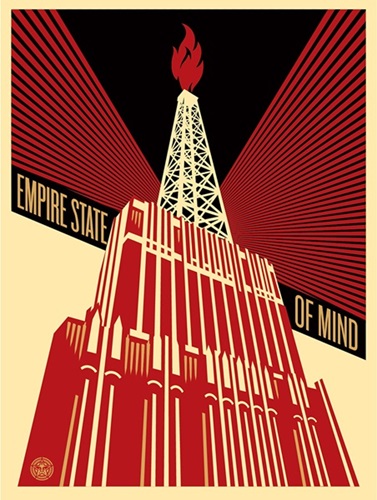
Oil & Gas Building is a 2014 Shepard Fairey screen print, 18 x 24 inches, signed and numbered in an edition of 450 with a limit of one per person, published by Obey Giant and released February 27, 2014, at 45 dollars. The image renders a monolithic industrial skyscraper in Fairey's graphic style. In his text he argues the print is about the volatility of giving the oil and gas industry too much power to shape politics despite environmental and climate dangers, criticizing fossil-fuel subsidies, industry political donations, and the suppression of renewable alternatives like electric cars.
Why It Matters
Oil & Gas Building is among Fairey's most pointed environmental and anti-corporate-power statements, pairing an imposing architectural symbol of industrial dominance with a detailed critique of fossil-fuel influence over politics. His accompanying text is essay-length and data-laden, citing roughly 25 billion in oil and gas tax breaks, 238.7 million in industry political donations since 1990, the BP spill, and the overturning of California's zero-emissions law, making the print a vehicle for a sustained argument about money, energy, and policy. Visually, it uses the iconic industrial skyscraper, in the lineage of the Chrysler and General Electric buildings, as a monument to power whose grandeur masks dangerous influence. The work crystallizes Fairey's environmental advocacy at a moment of intensifying climate debate, calling for investment in renewables over subsidizing obsolescent fossil fuels. For collectors, it is a strong example of his issue-driven poster-propaganda practice, combining architectural imagery with explicit environmental and corporate critique. The edition of 450 with a one-per-household limit reflects a release aimed at broad, accessible circulation of the message rather than scarcity, consistent with its activist intent.
Collector Perspective
This print appeals to collectors focused on Fairey's environmental and anti-corporate-power work, and to those who value art with a clear, documented political argument. The monolithic-building imagery gives it strong graphic presence, and at 18 x 24 inches it frames cleanly alongside his other climate and corporate-critique prints. The edition of 450 with a one-per-household limit kept it widely accessible at release. It fits a collection built around Fairey's environmental themes and his critiques of industry and money in politics. Collectors who appreciate Fairey's detailed accompanying essays will find this one especially substantive, adding context and conversation value on display.
Historical Context
Released in February 2014 by Obey Giant, Oil & Gas Building belongs to Fairey's growing body of environmental and anti-corporate work in the 2010s. It frames the oil and gas industry's political influence as a threat to climate progress, referencing fossil-fuel subsidies, industry donations, the BP disaster, and the delay of electric cars in California. The print uses the industrial skyscraper as a symbol of corporate dominance, situating it within American iconography of industrial pride while subverting that pride into critique. Within Fairey's arc it reflects his deepening engagement with climate and energy politics, using the editioned poster as a platform for detailed advocacy.
FAQ
What is Oil & Gas Building about?
Per Fairey's text, it addresses the volatility of giving the oil and gas industry too much power to manipulate politics despite dangers to the environment and climate change. He calls for funding renewable alternatives instead of subsidizing fossil fuels.
What figures does Fairey cite?
He cites approximately 25 billion in tax breaks and subsidies to the oil and gas industries, 238.7 million in industry-affiliated political donations since the 1990 cycle, the BP explosion and spill, and the overturning of California's zero-emissions law.
What are the edition details?
It is an 18 x 24 inch screen print, signed and numbered in an edition of 450, limited to one per person or household, published by Obey Giant and released February 27, 2014, at 45 dollars.
How does the image use the building?
Fairey presents the building as a monolithic monument to industrial power, in the lineage of landmarks like the Chrysler and General Electric buildings, using it to symbolize how industrial dominance correlates to disproportionate political influence.
Related Works


About the Artist

Shepard Fairey (b. 1970, Charleston, South Carolina) is an American street artist, graphic designer, and activist, and a graduate of the Rhode Island School of Design. His 1989 “André the Giant Has a Posse” sticker grew into the global OBEY GIANT campaign — an ongoing experiment in propaganda, obedience, and visual culture. He reached worldwide recognition with the 2008 “Hope” portrait of Barack Obama, now held by the Smithsonian National Portrait Gallery. Across screen prints, stencils, murals, and collage, Fairey channels propaganda aesthetics toward themes of peace, justice, environmentalism, and civil rights. His work is in the collections of the Museum of Modern Art, the Victoria & Albert Museum, and LACMA.