Gauntlet Gallery
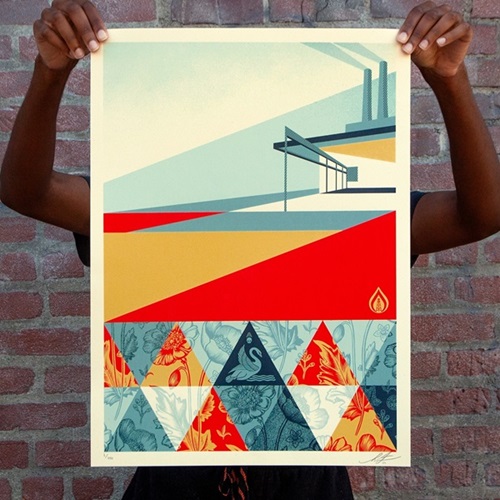
What is Shepard Fairey’s piece called “Corporate Welfare”?
Artist Statement
This print is a comment on corporate subsidy. While average Americans struggle to make ends meet, many profitable industries and corporations receive tax breaks and subsidies. This is due to the dangerously disproportionate influence corporations have on politics and policy. Too much power under current campaign finance structure yields the ability for corporations to manipulate politics. A lot of people freaked out that the Obama administration lost taxpayers about $600 million by investing in Solyndra, a solar panel company developing a new technology, which went bankrupt. However, few people seem upset that the U.S. government gives approximately $70 billion in tax breaks and subsidies to the highly profitable oil and gas industries. Green Energy companies only received 12 billion in subsidy because they don't have the deep pockets of fossil fuel companies. The Solyndra investment did not work out, but the need to fund new, renewable technologies, should be obvious when the rapidly depleting oil and gas sources become more difficult and dangerous to extract each passing day. The only reason the government subsidies are so disproportionate is because of the massive power the dying oil and gas industry still has. The Oil & Gas industry, which includes multi-national and independent oil and gas producers and refiners, natural gas pipeline companies, gasoline service stations and fuel oil dealers, has long enjoyed a history of strong influence in Washington. Individuals and political action committees affiliated with oil and gas companies have donated $238.7 million to candidates and parties since the 1990 election cycle, 75 percent of which has gone to Republicans. -Shepard 18 x 24 inch screen print on cream speckle tone paper. Signed and numbered edition of 450. $55. A portion of the proceeds to benefit Rootstrikers and Represent.US
Summary
"Corporate Welfare" is a 2015 Shepard Fairey screen print published by Obey Giant, measuring 18 x 24 inches on cream speckle tone paper as a signed and numbered first edition of 450, released at $55. The work is a pointed comment on corporate subsidy, contrasting the tax breaks and subsidies that profitable oil and gas industries receive with the struggles of average Americans. Fairey's text references the disproportionate political influence of fossil-fuel companies, the Solyndra controversy, and lopsided energy subsidies. A portion of the proceeds was designated to benefit Rootstrikers and Represent.US, anti-corruption advocacy organizations.
Why It Matters
"Corporate Welfare" is one of Fairey's most explicitly argued political prints of 2015, accompanied by a detailed source statement laying out a critique of corporate subsidy and campaign-finance influence. Fairey contrasts the public outcry over the roughly $600 million Solyndra loss with the far larger tax breaks and subsidies flowing to the oil and gas industry, and cites figures on fossil-fuel political donations since 1990. This level of stated policy argument distinguishes the print from his more decorative or slogan-based editions and ties it firmly to themes of money in politics and energy policy. The proceeds component adds another layer of significance: a portion was designated to benefit Rootstrikers and Represent.US, anti-corruption advocacy groups, linking the artwork to concrete reform efforts. For a database, the rich documented intent and the charitable designation make this a substantive entry within Fairey's environmental and political work. Collectors who prioritize works with clear activist content and a measurable cause connection will value it, and it serves as a strong example of how Fairey paired affordable editions with pointed commentary on corporate power during the mid-2010s.
Collector Perspective
This print appeals to collectors focused on Fairey's political and anti-corporate work, particularly those drawn to its detailed subsidy critique and its tie to anti-corruption groups Rootstrikers and Represent.US. The explicit messaging makes it a strong anchor for a wall themed around money in politics, energy policy, or activism. At 18 x 24 inches on cream speckle tone paper, signed and numbered in an edition of 450, it is a substantial yet accessible acquisition at its $55 original price. It fits a collection organized around Fairey's environmental and political series, where its documented argument and charitable connection add display interest and a clear narrative, appealing to mission-minded collectors as much as design-focused ones.
Historical Context
"Corporate Welfare" sits within Fairey's mid-2010s body of issue-driven editions, where he repeatedly targeted corporate power, fossil-fuel influence, and campaign finance. The print's detailed text and its designation of proceeds to Rootstrikers and Represent.US reflect how Fairey increasingly linked individual works to specific advocacy organizations during this period. By 2015 he was an established political artist whose screen prints functioned as both collectible objects and vehicles for argument, and this piece exemplifies that dual role. Within his arc it belongs to a recurring strand of anti-corruption and energy-policy work that connects to other oil-and-gas-themed prints across his catalog, demonstrating the continuity of his concern with corporate influence over democracy throughout the decade.
FAQ
What is the message of this print?
Fairey describes it as a comment on corporate subsidy, arguing that profitable industries receive tax breaks and subsidies while average Americans struggle. He focuses on the disproportionate political influence of the oil and gas industry and the imbalance between fossil-fuel and green-energy subsidies under current campaign-finance structures.
Does this print support a cause?
Yes. According to the source, a portion of the proceeds was designated to benefit Rootstrikers and Represent.US, two anti-corruption advocacy organizations. This links the artwork to concrete reform efforts addressing money in politics, consistent with the print's subject matter.
What are the production details?
It is an 18 x 24 inch screen print on cream speckle tone paper, signed and numbered in a first edition of 450. It was published by Obey Giant in 2015 with a release date of August 11, 2015, and an original price of $55.
What examples does Fairey cite in the print's statement?
Fairey references the roughly $600 million loss from the Solyndra investment, the approximately $70 billion in tax breaks for oil and gas versus far less for green energy, and notes that oil-and-gas-affiliated donors gave $238.7 million to candidates and parties since the 1990 election cycle, mostly to Republicans.
Related Works
About the Artist

Shepard Fairey (b. 1970, Charleston, South Carolina) is an American street artist, graphic designer, and activist, and a graduate of the Rhode Island School of Design. His 1989 “André the Giant Has a Posse” sticker grew into the global OBEY GIANT campaign — an ongoing experiment in propaganda, obedience, and visual culture. He reached worldwide recognition with the 2008 “Hope” portrait of Barack Obama, now held by the Smithsonian National Portrait Gallery. Across screen prints, stencils, murals, and collage, Fairey channels propaganda aesthetics toward themes of peace, justice, environmentalism, and civil rights. His work is in the collections of the Museum of Modern Art, the Victoria & Albert Museum, and LACMA.