Gauntlet Gallery
What is Shepard Fairey’s piece called “Warning Surveillance”?
Artist Statement
Warning Surveillance Screen Print 18 x 24 inches Edition of 110
Summary
Warning Surveillance is a 2000 screen print, 18 x 24 inches, published by Obey Giant in a first edition of 110. The source provides only the title, medium, dimensions, and edition size, with no description of the specific imagery. Its title points to a surveillance theme, and the record notes a peace and anti-war secondary theme. It belongs to Fairey's early Obey Giant screen prints from around the turn of the millennium, extending the watching-and-authority motifs that run through his OBEY-era work.
Why It Matters
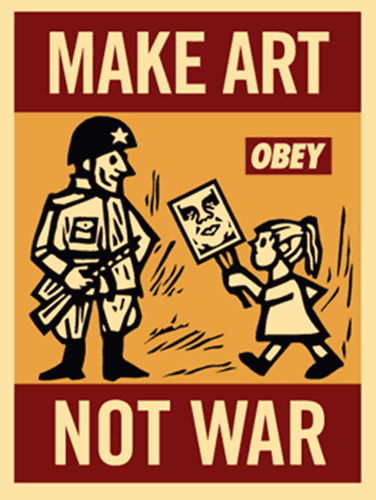
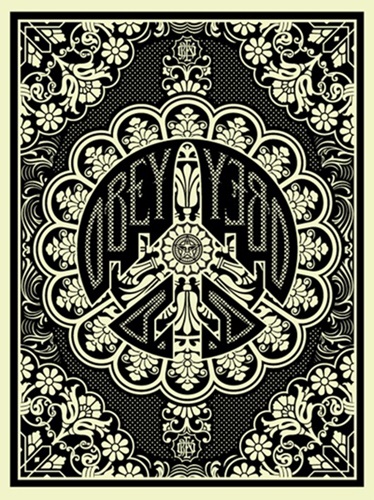
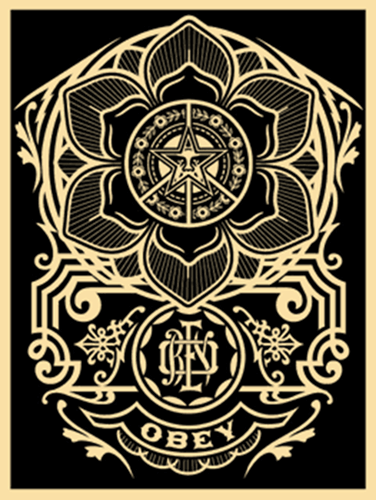
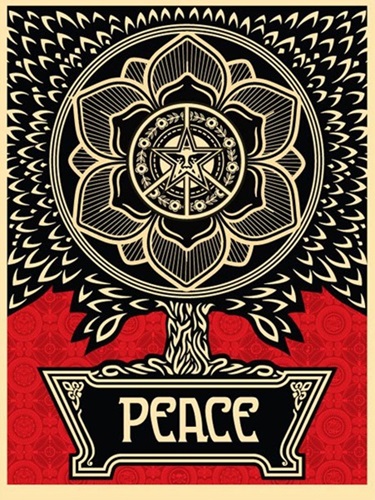
Warning Surveillance extends Fairey's recurring surveillance theme into the year 2000, sitting close to his Big Brother prints and reinforcing a thread of authority-and-watching imagery that defines much of his OBEY-era output. The title's warning language frames surveillance as a danger, while the record's peace and anti-war secondary theme links it to the broader social-critique strand Fairey pursued across his career. As a first edition of 110, it is a small early run that collectors track when assembling a view of his turn-of-the-millennium work. Although the source omits a description, the title and secondary theme give clear thematic direction, connecting the piece both to his surveillance motif and to the peace-oriented imagery seen in later works like Make Art Not War and the Peace series. For a knowledge graph, the responsible value lies in positioning Warning Surveillance within these documented thematic families while leaving the precise imagery undocumented. Collectors interested in Fairey's surveillance critique or his anti-war messaging will find this an early, relevant edition that bridges those two strands of his project.
Collector Perspective
Warning Surveillance appeals to collectors focused on Fairey's surveillance critique and to those drawn to his peace and anti-war themes, which the record flags as a secondary theme. As a 2000 first edition of 110, it is a small early run that fits a chronological grouping of his turn-of-the-millennium prints or a thematic set around watching and authority. Because the source carries no description, the imagery is undocumented here, so buyers should review images before purchase. For display, it pairs well with his Big Brother editions and with later peace-themed works, where the surveillance and anti-war threads it bridges create a coherent narrative.
Historical Context
Warning Surveillance dates to 2000, within Fairey's early Obey Giant period around the turn of the millennium, and continues the surveillance motif prominent in his 1999 Big Brother prints. The record also assigns a peace and anti-war secondary theme, linking it to the social-critique imagery Fairey developed throughout his career, later visible in works such as Make Art Not War and his Peace series. With the source supplying date, medium, and edition size but no imagery description, the print's place in his arc is anchored by these facts and by its documented thematic ties to both surveillance and anti-war messaging.
FAQ
What is Warning Surveillance?
It is a 2000 Shepard Fairey screen print, 18 x 24 inches, published by Obey Giant in a first edition of 110. The record lists title, medium, dimensions, and edition size but contains no description of the imagery.
What themes does it address?
The title points to a surveillance theme, and the source assigns a peace and anti-war secondary theme, connecting the print both to Fairey's watching-and-authority motif and to his broader social-critique imagery.
How large is the edition?
The source lists a first edition of 110, published by Obey Giant. No additional editions are noted in the record.
What does the print depict?
The source does not describe the imagery, so the specific visual content is not documented here. The title and secondary theme indicate surveillance and anti-war concerns, but buyers should consult images to confirm the subject.
Related Works
About the Artist

Shepard Fairey (b. 1970, Charleston, South Carolina) is an American street artist, graphic designer, and activist, and a graduate of the Rhode Island School of Design. His 1989 “André the Giant Has a Posse” sticker grew into the global OBEY GIANT campaign — an ongoing experiment in propaganda, obedience, and visual culture. He reached worldwide recognition with the 2008 “Hope” portrait of Barack Obama, now held by the Smithsonian National Portrait Gallery. Across screen prints, stencils, murals, and collage, Fairey channels propaganda aesthetics toward themes of peace, justice, environmentalism, and civil rights. His work is in the collections of the Museum of Modern Art, the Victoria & Albert Museum, and LACMA.