Gauntlet Gallery
What is Shepard Fairey’s piece called “Mao Stamp”?
Artist Statement
MAO STAMP Screen Print 18 x 24 inches Edition of 200
Summary
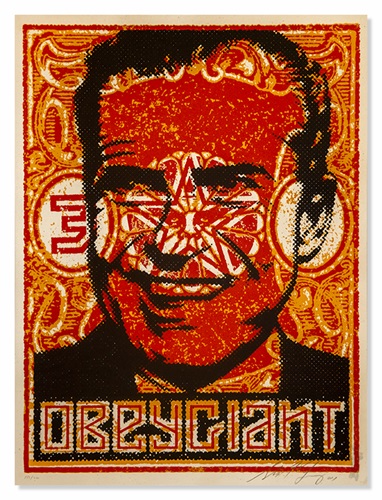
Mao Stamp is a 2000 screen print published by Obey Giant in a first edition of 200, measuring 18 x 24 inches. The work renders the familiar likeness of Chairman Mao Zedong in a stamp-style format, treating an icon of 20th-century political imagery through Fairey's flat, propaganda-derived graphic vocabulary. By framing Mao within the visual convention of a postage stamp, the print plays on how states circulate and authorize official portraits, recasting a loaded political symbol as appropriated pop iconography.
Why It Matters
Mao Stamp sits squarely within Fairey's long-running interest in repurposing the visual language of state power and propaganda. Mao Zedong's portrait is one of the most reproduced political images of the 20th century, and by reissuing it in a stamp format Fairey extends a lineage that runs from Warhol's Mao silkscreens through the broader Pop tradition of appropriating mass-circulated icons. For collectors, the print is valuable as a node in Fairey's recurring engagement with the Mao motif, which he returned to across multiple works including a 1998 print, a 2001 banner, and a 2003 collage. The stamp conceit is pointed: a postage stamp is a small, official, state-sanctioned act of portraiture, and pulling that device into street-derived art questions who gets to authorize and distribute an image. The edition of 200 is modest, placing it among Fairey's earlier, smaller releases from the Obey Giant studio. Without inventing market claims, its appeal rests on its clear thematic ties to the propaganda and pop-appropriation threads that define this period of his output, and on its place in a recognizable mini-series of Mao-themed works.
Collector Perspective
This print appeals to collectors drawn to Fairey's propaganda-and-pop-appropriation works and to those building a thematic group around his recurring Mao motif. It pairs naturally with the 1998 Mao print, the 2001 Mao Banner, and the 2003 Mao Collage, making it a logical acquisition for anyone assembling that arc. At 18 x 24 inches it is a manageable, frame-friendly size for a home or office wall, and the stamp-format composition gives it a self-contained, graphic punch that reads well on its own or in a grid of related works. Collectors who appreciate the dialogue with Warhol's Pop appropriations will find it a clear, legible example of Fairey working in that vein. The first edition of 200 is a relatively small run for the period, which supports its standing as a focused collector's piece rather than a mass-market poster.
Historical Context
Mao Stamp dates to 2000, a period when Fairey's Obey Giant studio was producing a steady stream of screen prints that mined propaganda iconography and pop appropriation. This sits after his foundational late-1980s and 1990s sticker and Andre the Giant work and within the early Posters and Propaganda phase, when he was sharpening the visual grammar later codified in the OBEY brand. The Mao subject reflects his ongoing fascination with how authoritarian regimes deploy portraiture, a thread he revisited repeatedly: a 1998 Mao print preceded this stamp, and a 2001 banner and 2003 collage followed. Treating Mao through Western Pop conventions also places Fairey in conversation with Warhol's earlier Mao series, situating this print at the intersection of street-derived practice and gallery-oriented Pop lineage.
FAQ
What is the edition size of Mao Stamp?
Mao Stamp is a first edition of 200, published by Obey Giant in 2000. This is a relatively small run for the period, and the edition size is stated directly in the record's description.
What are the dimensions and medium?
It is a screen print measuring 18 x 24 inches, as listed in the source record. The format and scale are consistent with Fairey's other Obey Giant studio prints from the same year.
Why does Fairey use a stamp format for Mao?
Framing Mao Zedong as a postage stamp plays on how states officially authorize and circulate political portraits. Fairey appropriates that convention to comment on propaganda and image-distribution, consistent with his broader propaganda-themed work.
How does this relate to his other Mao works?
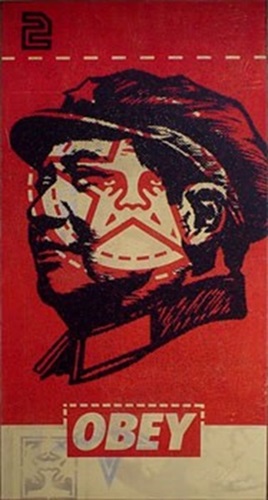
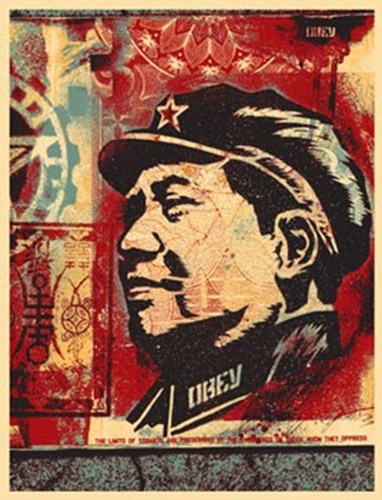
Mao Stamp is part of a recurring Mao motif in Fairey's output, alongside a 1998 Mao print, a 2001 Mao Banner, and a 2003 Mao Collage, making it a logical piece for collectors assembling that thematic group.
Related Works


About the Artist

Shepard Fairey (b. 1970, Charleston, South Carolina) is an American street artist, graphic designer, and activist, and a graduate of the Rhode Island School of Design. His 1989 “André the Giant Has a Posse” sticker grew into the global OBEY GIANT campaign — an ongoing experiment in propaganda, obedience, and visual culture. He reached worldwide recognition with the 2008 “Hope” portrait of Barack Obama, now held by the Smithsonian National Portrait Gallery. Across screen prints, stencils, murals, and collage, Fairey channels propaganda aesthetics toward themes of peace, justice, environmentalism, and civil rights. His work is in the collections of the Museum of Modern Art, the Victoria & Albert Museum, and LACMA.