Gauntlet Gallery
What is Shepard Fairey’s piece called “Zapatista”?
Artist Statement
Screen Print 18 x 24 inches Edition of 200
Summary
Zapatista is a 2001 Shepard Fairey screen print published by Obey Giant in a first edition of 200, measuring 18 x 24 inches. The work references the Zapatista movement, the Indigenous-led revolutionary struggle from Chiapas, Mexico, channeling its imagery of masked insurgents and resistance through Fairey's propaganda-poster aesthetic. Built on flat color, bold graphic framing, and the OBEY visual system, it aligns Fairey's image-making with a real-world movement of grassroots rebellion. It is a mid-size early-period screen print typical of Fairey's Obey Giant studio output around 2001.
Why It Matters
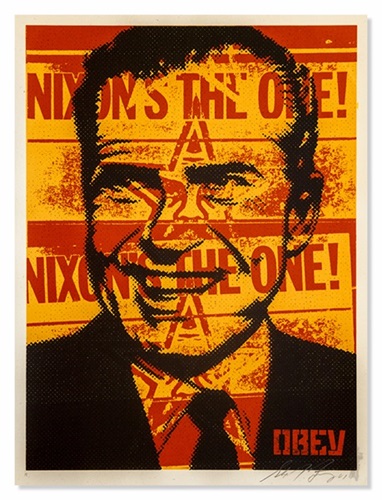
Zapatista marks Fairey engaging directly with a real revolutionary movement, an early instance of the explicit political solidarity that would become a defining strand of his work. The Zapatista uprising, with its iconography of masked Indigenous insurgents and anti-globalization resistance, is a natural subject for an artist whose propaganda style interrogates power, obedience, and rebellion. For collectors, this 2001 piece sits in the formative Obey Giant period and shows Fairey extending his visual grammar from abstract iconography toward documented political struggle. The source-stated first edition of 200 keeps it a contained early run. Within his catalog it connects to other 2001 political-leaning releases like Ministry of Information and the Nixon prints, forming part of a cluster where Fairey wrestled with authority and resistance. As a documented screen print that aligns the OBEY machinery with a grassroots liberation movement, it gives collectors an early, clearly political example of Fairey's practice, valued for how it ties his image-making to actual revolutionary symbolism rather than pure pop reference.
Collector Perspective
This print suits collectors who gravitate toward Fairey's political and activist work and toward the early Obey Giant period. Its Zapatista subject anchors it in revolutionary and social-justice iconography, making it a strong fit for collections built around resistance, propaganda, and grassroots movements. At 18 x 24 inches it frames easily and pairs well with the other 2001 political-leaning Obey Giant releases. Its bold, high-contrast graphic treatment gives it solid wall presence. With a documented first edition of 200, it offers a moderately scarce, thematically focused entry into Fairey's early political work, attractive to buyers who want substance and a clear narrative thread rather than a celebrity portrait.
Historical Context
Zapatista belongs to Fairey's early Obey Giant studio era around 2001, when he was beginning to point the OBEY propaganda aesthetic at real political subjects. Referencing the Indigenous-led Zapatista movement that emerged from Chiapas, Mexico, the work signals Fairey's growing engagement with grassroots resistance and anti-globalization themes. This period followed the late-1990s OBEY sticker and poster campaigns that established his street presence and preceded the more openly political screen prints of the mid-2000s. It sits among a 2001 cohort of Obey Giant releases that increasingly treated power, authority, and rebellion as recurring concerns.
FAQ
What is Zapatista about?
It references the Zapatista movement, the Indigenous-led revolutionary struggle from Chiapas, Mexico, rendered in Fairey's propaganda-poster style. The 2001 work aligns the OBEY visual language with a real-world movement of grassroots resistance.
What are the edition size and dimensions?
Per the source record it is a first edition of 200 and measures 18 x 24 inches. It was produced as a screen print published by Obey Giant, Shepard Fairey's studio imprint.
Where does it fit in Fairey's work?
It is an early example of Fairey engaging a real political movement, made during the formative Obey Giant period around 2001. It sits among a cluster of releases in which he increasingly addressed power, authority, and rebellion.
How scarce is this print?
With a stated first edition of 200 it falls in a moderately scarce tier. The source does not confirm availability or sold-out status, so this reflects documented edition size only, not current market supply.
Related Works



About the Artist

Shepard Fairey (b. 1970, Charleston, South Carolina) is an American street artist, graphic designer, and activist, and a graduate of the Rhode Island School of Design. His 1989 “André the Giant Has a Posse” sticker grew into the global OBEY GIANT campaign — an ongoing experiment in propaganda, obedience, and visual culture. He reached worldwide recognition with the 2008 “Hope” portrait of Barack Obama, now held by the Smithsonian National Portrait Gallery. Across screen prints, stencils, murals, and collage, Fairey channels propaganda aesthetics toward themes of peace, justice, environmentalism, and civil rights. His work is in the collections of the Museum of Modern Art, the Victoria & Albert Museum, and LACMA.