Gauntlet Gallery
What is Shepard Fairey’s piece called “Cash For Chaos”?
Artist Statement
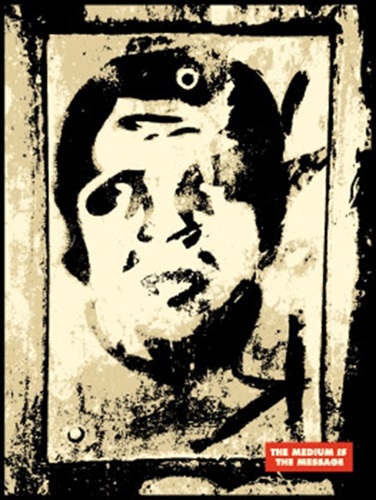
CASH FOR CHAOS Screen Print 18 x 24 inches Edition of 200
Summary
Cash For Chaos is a 2001 Shepard Fairey screen print published by Obey Giant in a first edition of 200, measuring 18 x 24 inches. The title borrows the language of consumer commerce and disorder, framing a graphic image that draws on Fairey's signature propaganda-poster vocabulary. As a sheet from his early-2000s output, it sits within his pop-culture and commentary work of the period. The source record confirms the medium, year, dimensions, and edition size but provides no extended artist statement, so the precise imagery beyond the title is not detailed here.
Why It Matters
Cash For Chaos belongs to Fairey's dense output of small-edition screen prints in the early 2000s, a stretch when he was rapidly expanding the OBEY visual language into pointed commentary on commerce, media, and power. The title itself plays on the collision of money and disorder, aligning with the corporate-critique and propaganda strains that run through this era of his work. For the collector, prints like this matter because they document Fairey's transition from pure street-poster icon-maker into an artist building a deliberate critique of consumer culture. The edition of 200 places it among the more limited sheets of the period, which gives it scarcity relative to his later large-run releases. Its value as a database entry lies in situating it among sibling 2001 prints rather than treating it as a standalone object. Because the source offers only the title and production facts, the interpretation here is deliberately cautious: the themes are inferred from Fairey's established vocabulary and the title's wording, not from a documented artist statement. That restraint is itself useful to a serious collector weighing the print against better-documented works from the same year.
Collector Perspective
This print appeals to collectors who focus on Fairey's early-2000s period and who value smaller editions over his later mass-market releases. At 18 x 24 inches, it is an approachable size for framing and fits comfortably into a grouping of period screen prints rather than dominating a wall on its own. Buyers assembling a survey of Fairey's commerce-and-power commentary, or those drawn to his propaganda-poster aesthetic, will find it a coherent fit. The edition of 200 gives it a measure of relative scarcity that completist collectors appreciate. Because documentation is thin, it is best suited to collectors comfortable doing their own provenance and condition checks rather than those seeking a marquee, heavily catalogued piece.
Historical Context
Cash For Chaos dates to 2001, a productive year in which Fairey issued numerous small-edition Obey Giant screen prints exploring consumerism, media, and propaganda imagery. This places it in his posters-and-propaganda phase, after the early OBEY sticker-and-icon campaigns of the late 1980s and 1990s but before the broader recognition he achieved later in the decade. The print's pop-culture-and-commentary framing is characteristic of how Fairey was using commercial and political visual language during this period to provoke reflection on power and consumption. Without an artist statement in the source, its exact subject is not elaborated, but its year, publisher, and edition firmly anchor it within this transitional stretch of his career.
FAQ
What year is Cash For Chaos and who published it?
Cash For Chaos was created in 2001 and published by Obey Giant, Shepard Fairey's own imprint. It is part of his early-2000s output of small-edition screen prints that explored consumer culture, media, and propaganda imagery.
What is the edition size and how large is the print?
It is a first edition limited to 200 copies. The screen print measures 18 x 24 inches, a standard mid-size format Fairey used frequently for his period poster works.
What medium is this print?
It is a screen print, produced using Fairey's signature stencil-and-poster graphic technique. The source record confirms the medium, year, dimensions, and edition but does not include an extended artist statement about the imagery.
How scarce is this print?
With an edition of 200, it is moderately scarce relative to Fairey's later large-run releases. The source does not confirm whether it is sold out, and no auction or market value is stated in the record.
Related Works

About the Artist

Shepard Fairey (b. 1970, Charleston, South Carolina) is an American street artist, graphic designer, and activist, and a graduate of the Rhode Island School of Design. His 1989 “André the Giant Has a Posse” sticker grew into the global OBEY GIANT campaign — an ongoing experiment in propaganda, obedience, and visual culture. He reached worldwide recognition with the 2008 “Hope” portrait of Barack Obama, now held by the Smithsonian National Portrait Gallery. Across screen prints, stencils, murals, and collage, Fairey channels propaganda aesthetics toward themes of peace, justice, environmentalism, and civil rights. His work is in the collections of the Museum of Modern Art, the Victoria & Albert Museum, and LACMA.