Gauntlet Gallery
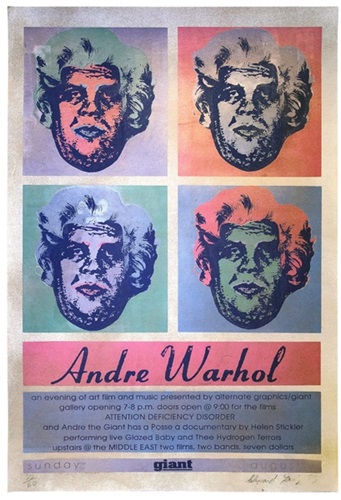
What is Shepard Fairey’s piece called “Marilyn Warhol”?
Artist Statement
Andy Warhol was a big inspiration because he made a mockery of the fine art world, taking press stills and household items and turning them into high art. I felt like what I was doing was pop art in a similar vein, but I was taking it even further outside the institutions and straight to the street. I remember when I was making t-shirts, somebody said, "Isn't it amazing that you're taking one of the ugliest images ever and putting it on a shirt, and people are buying it up as fashion?" I had the idea of taking that a step further by taking Marilyn's sex symbol face and changing that into Andre's ugly face. Andre wasn't a handsome man and he's even a more hideous woman, but people loved the humor of the poster and snapped it up anyway. Signed and numbered edition of 140. 18 x 24 inch screen print.
Summary
Marilyn Warhol is a 2000 screen print published by Obey Giant, a signed and numbered edition of 140 measuring 18 x 24 inches. The work superimposes the Andre the Giant face onto the format of Marilyn Monroe's famous image, swapping a celebrated sex-symbol portrait for what Fairey calls Andre's 'ugly' visage. Conceived as a direct nod to Andy Warhol, it pushes Pop appropriation toward humor and the street, turning an icon of glamour into a deliberately unglamorous OBEY motif.
Why It Matters
Marilyn Warhol is one of Fairey's most explicit statements of his debt to Andy Warhol, and the source description makes that lineage unusually clear in his own words. Fairey describes Warhol as a major inspiration for taking press stills and household items and turning them into high art, and frames his own work as pop art carried even further outside institutions and onto the street. The print enacts that idea by hijacking the most recognizable Pop portrait of all, the Marilyn image, and replacing the sex-symbol face with Andre the Giant. The humor is the point: Fairey recounts how people loved the joke of a deliberately ugly image being snapped up as fashion, echoing his t-shirt-era experience. For collectors, this is a key bridge work connecting the OBEY Andre iconography to the Pop-appropriation tradition, and its self-aware commentary on glamour, ugliness, and consumer desire gives it more conceptual weight than a typical Obey Giant graphic. As a signed and numbered edition of 140, it is a smaller, more personal release, and its documented backstory makes it especially attractive to collectors who value works with Fairey's own stated intent.
Collector Perspective
This print is a natural fit for collectors who anchor their holdings in OBEY iconography and the Andre the Giant face, as well as Pop-art enthusiasts who appreciate the direct Warhol reference. The documented artist statement makes it a storytelling piece, ideal for collectors who like works that come with the maker's own explanation of intent. At 18 x 24 inches it frames easily and pairs well with other Andre-based works such as Andre Warhol and the Half Face and Double Face prints. As a signed and numbered edition of 140, it sits among the smaller, more collectible runs from this period. Its blend of humor, recognizable source imagery, and clear conceptual hook gives it broad display appeal, working as both a focal piece and an anchor for a Pop-appropriation grouping.
Historical Context
Marilyn Warhol dates to 2000 and belongs to the phase when Fairey was consolidating the OBEY Andre the Giant iconography while openly engaging the Pop-art canon. The source ties it back to his t-shirt-making period and his foundational practice of moving images from the street into wearable and collectible form. By explicitly invoking Warhol's Marilyn, Fairey positions himself within a lineage running from Warhol's celebrity silkscreens into street-derived appropriation. The work predates his later overtly political and Obama-era output, capturing a moment when his subject matter still centered on the Andre face, brand-building, and art-world commentary rather than electoral or activist messaging. It documents, in his own words, the deliberate inversion of glamour into ugliness that characterized his early Pop strategy.
FAQ
What is Marilyn Warhol depicting?
It places the Andre the Giant face into the format of Marilyn Monroe's famous image, swapping a sex-symbol portrait for what Fairey calls Andre's ugly visage. The source describes this as a deliberate, humorous inversion of glamour.
Is this print signed and numbered?
Yes. The source record states it is a signed and numbered edition of 140, an 18 x 24 inch screen print published by Obey Giant in 2000.
How is it connected to Andy Warhol?
Fairey cites Warhol as a major inspiration for turning press stills and everyday items into high art. The title and Marilyn format are a direct homage, with Fairey extending Pop appropriation outside institutions and onto the street.
Why use an intentionally unflattering image?
Fairey recounts the appeal of taking an ugly image and having people buy it as fashion. Replacing Marilyn's glamour with Andre's face turns that joke into the print's central idea about desire and consumption.
Related Works

About the Artist

Shepard Fairey (b. 1970, Charleston, South Carolina) is an American street artist, graphic designer, and activist, and a graduate of the Rhode Island School of Design. His 1989 “André the Giant Has a Posse” sticker grew into the global OBEY GIANT campaign — an ongoing experiment in propaganda, obedience, and visual culture. He reached worldwide recognition with the 2008 “Hope” portrait of Barack Obama, now held by the Smithsonian National Portrait Gallery. Across screen prints, stencils, murals, and collage, Fairey channels propaganda aesthetics toward themes of peace, justice, environmentalism, and civil rights. His work is in the collections of the Museum of Modern Art, the Victoria & Albert Museum, and LACMA.