Gauntlet Gallery
What is Shepard Fairey’s piece called “RI Bridge (First Edition)”?
Artist Statement
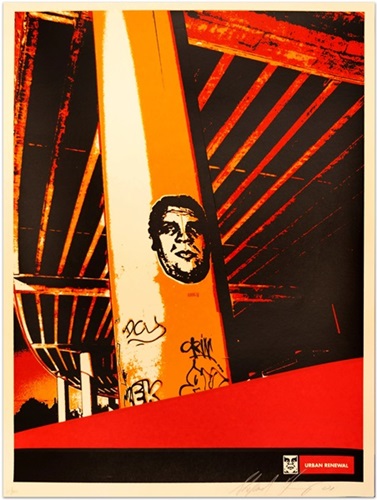
Urban Renewal series Image of the Seekonk Bridge in Providence, RI, an old railroad bridge that was permanently raised in 1981.
Summary
RI Bridge is a 2000 screen print from Fairey's Urban Renewal series, published by Obey Giant in a first edition of 200 and measuring 18 x 24 inches. It depicts the Seekonk Bridge in Providence, Rhode Island, an old railroad bridge that was permanently raised in 1981. Rendered in Fairey's flat graphic style, the print turns a disused piece of industrial infrastructure into a stark architectural subject, reflecting the series' interest in the decaying urban environments that shaped his early street practice.
Why It Matters
RI Bridge matters as part of Fairey's Urban Renewal series, a body of work that turns away from portraiture toward the built environment and the industrial landscapes of the cities where he worked. The specific subject, the Seekonk railroad bridge in Providence, ties the print directly to Rhode Island, where Fairey attended the Rhode Island School of Design and where the Andre the Giant project began, giving it a biographical resonance beyond its surface image. Documenting a bridge that was permanently raised in 1981 frames the work around obsolescence and the afterlife of infrastructure, themes that align with the decaying, poster-covered cityscapes that nurtured his early sticker and wheatpaste campaigns. For collectors, the Urban Renewal context distinguishes it from his more iconographic Mao and Andre works, offering a quieter, place-specific subject. The edition of 200 is a modest run, and the listed reference price of 50 in the source indicates it was offered as an accessible studio release rather than a premium edition. Its value lies in its documentary specificity and its connection to the Providence environment central to Fairey's origins.
Collector Perspective
RI Bridge appeals to collectors interested in Fairey's Urban Renewal series and in works tied to specific places, particularly Providence and his Rhode Island roots. It is a strong fit for those who prefer architectural and infrastructural subjects over portraiture, and for collectors assembling a thematic group of his cityscape and industrial prints. At 18 x 24 inches it frames cleanly and reads well alongside related Urban Renewal works such as Skyline, Tracks Poster, and Worker. As a first edition of 200 with a modest listed reference price, it represents a relatively accessible entry point into the period. Its restrained, place-specific imagery gives it a documentary, almost photographic appeal that suits collectors who value narrative and locality as much as graphic punch.
Historical Context
RI Bridge sits within the Urban Renewal series, a 2000-era strand of Fairey's output focused on the industrial and architectural fabric of American cities. Coming after his foundational late-1980s and 1990s street campaigns, it reflects a maturing interest in the urban environments that hosted his wheatpaste and sticker work. The Seekonk Bridge subject anchors the print to Providence, the city tied to his time at the Rhode Island School of Design and the birthplace of the Andre the Giant project, lending it autobiographical weight. By memorializing a railroad bridge permanently raised in 1981, the work engages obsolescence and the layered, decaying surfaces of the city, themes consistent with the Posters and Propaganda phase when Fairey was broadening his subject matter beyond brand iconography.
FAQ
What does RI Bridge depict?
It depicts the Seekonk Bridge in Providence, Rhode Island, an old railroad bridge that was permanently raised in 1981. The source identifies it as part of Fairey's Urban Renewal series of cityscape subjects.
What series does this print belong to?
The source places it in the Urban Renewal series, a body of work focused on industrial and architectural urban subjects rather than the portraiture and iconography seen in many of Fairey's other prints.
What is the edition size and size?
It is a first edition of 200, published by Obey Giant in 2000, and measures 18 x 24 inches as a screen print. These details come directly from the source record.
Why is the Providence location significant?
Providence is closely tied to Fairey's origins, including his time at the Rhode Island School of Design and the start of the Andre the Giant project. The specific local subject gives the print a place-based, documentary quality.
Related Works
About the Artist
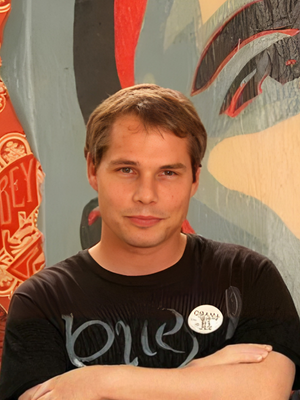
Shepard Fairey (b. 1970, Charleston, South Carolina) is an American street artist, graphic designer, and activist, and a graduate of the Rhode Island School of Design. His 1989 “André the Giant Has a Posse” sticker grew into the global OBEY GIANT campaign — an ongoing experiment in propaganda, obedience, and visual culture. He reached worldwide recognition with the 2008 “Hope” portrait of Barack Obama, now held by the Smithsonian National Portrait Gallery. Across screen prints, stencils, murals, and collage, Fairey channels propaganda aesthetics toward themes of peace, justice, environmentalism, and civil rights. His work is in the collections of the Museum of Modern Art, the Victoria & Albert Museum, and LACMA.