Gauntlet Gallery
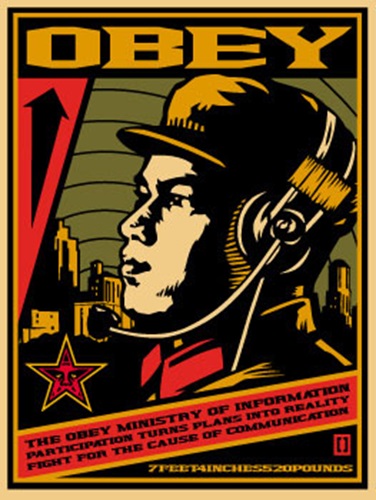
What is Shepard Fairey’s piece called “Tracks Poster”?
Artist Statement
Tracks Poster Screen Print 18 x 24 inches Edition of 200
Summary
Tracks Poster is a 2000 screen print by Shepard Fairey, published by Obey Giant in a first edition of 200. Printed at 18 x 24 inches, the work falls within Fairey's early collaboration and pop-culture output. The supplied record carries only the catalog facts: title, medium, dimensions, year, and edition size, with no narrative description of the imagery provided. As a small-edition screen print from this period, it sits among the wave of OBEY studio releases that built Fairey's visual vocabulary in the early 2000s.
Why It Matters
Tracks Poster belongs to Fairey's pivotal early-2000s screen-print period, when the OBEY Giant studio was producing a steady stream of small-edition works that translated his street-poster sensibility into collectible prints. With only 200 in the edition, it is the kind of comparatively modest run that appeals to collectors tracing the OBEY catalog chronologically rather than chasing a single iconic image. The record classifies it under collaborations and pop culture, situating it alongside other 2000-2001 Obey Giant releases that shared a print-shop aesthetic and a do-it-yourself ethos. For a knowledge graph, its value is less about a famous subject and more about completeness: it documents a specific point in Fairey's transition from purely street-level propaganda toward a structured studio practice. Collectors who value provenance and a full chronology of the early OBEY years treat prints like this as connective tissue. Because the supplied source omits a description of the actual imagery, claims about its message or symbolism are held cautiously here; what is firmly supported is its place as an authentic, dated, small-edition Obey Giant screen print from the formative period of Fairey's fine-art career.
Collector Perspective
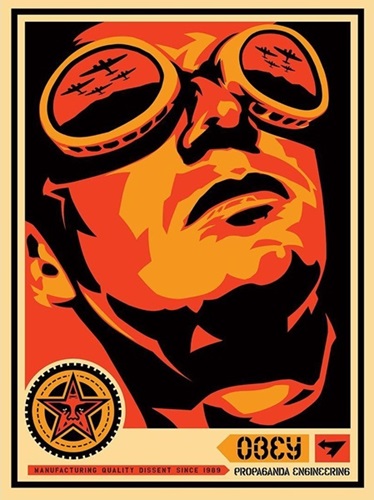
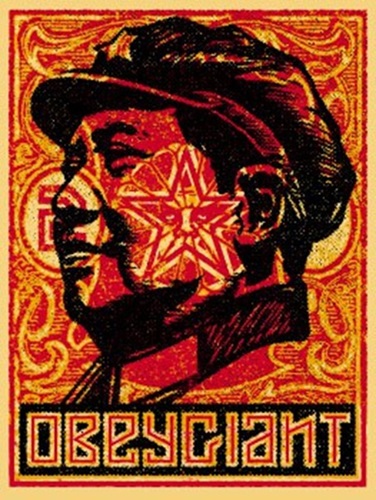
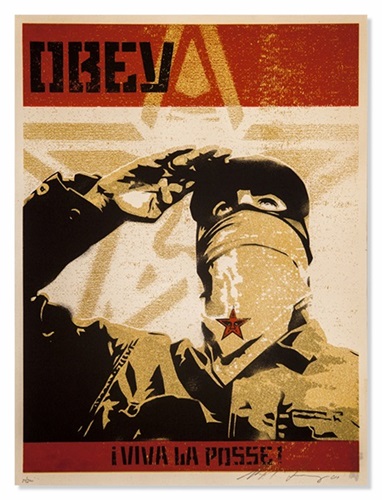
This print suits collectors building a chronological OBEY Giant archive, particularly those focused on the early studio years around 2000. With an edition of 200 and standard 18 x 24-inch dimensions, it is an accessible, frame-friendly size that fits comfortably in a gallery wall of period-matched Fairey works. Its appeal is to completists and students of Fairey's catalog rather than to buyers seeking a single trophy image. Displayed among other 2000-2001 Obey Giant releases such as Goggles, Mao Stamp, or Zapatista, it reinforces a cohesive early-era grouping. Because the record provides no described imagery, prospective buyers should confirm visual details directly before purchase.
Historical Context
Tracks Poster dates to 2000, a formative stretch in Shepard Fairey's career when the OBEY Giant studio was consolidating its print output following years of street-level sticker and poster campaigns rooted in his late-1980s Andre the Giant imagery. The early 2000s saw Fairey issuing numerous small-edition screen prints through Obey Giant, many grouped under collaborations and pop-culture themes, as he moved from guerrilla wheatpasting toward a sustained fine-art practice. This print sits squarely in that body of work, sharing the period, publisher, and screen-print medium of contemporaries like Goggles and Mao Stamp. It predates Fairey's later breakout into broadly recognized political imagery, making it part of the foundational catalog that collectors use to map his early trajectory.
FAQ
When was Tracks Poster made and who published it?
Tracks Poster was created in 2000 and published by Obey Giant, Shepard Fairey's own studio imprint. It belongs to the early-2000s wave of small-edition screen prints the studio issued during Fairey's transition from street campaigns to a structured fine-art print practice.
What is the edition size and medium?
It is a screen print produced in a first edition of 200. Screen printing was Fairey's primary fine-art medium during this period, used across many of his 2000-2001 Obey Giant releases.
What are the dimensions?
The print measures 18 x 24 inches, a standard poster size Fairey used frequently in his early-2000s output. The vertical format makes it an accessible, frame-friendly piece for collectors assembling period-matched groupings.
How does it fit into Fairey's catalog?
It is an early OBEY-era work classified under collaborations and pop culture. Collectors value it less as a single iconic image and more as part of a complete chronology documenting Fairey's formative studio years around 2000.
Related Works

About the Artist

Shepard Fairey (b. 1970, Charleston, South Carolina) is an American street artist, graphic designer, and activist, and a graduate of the Rhode Island School of Design. His 1989 “André the Giant Has a Posse” sticker grew into the global OBEY GIANT campaign — an ongoing experiment in propaganda, obedience, and visual culture. He reached worldwide recognition with the 2008 “Hope” portrait of Barack Obama, now held by the Smithsonian National Portrait Gallery. Across screen prints, stencils, murals, and collage, Fairey channels propaganda aesthetics toward themes of peace, justice, environmentalism, and civil rights. His work is in the collections of the Museum of Modern Art, the Victoria & Albert Museum, and LACMA.