Gauntlet Gallery
What is Shepard Fairey’s piece called “Fossil Factory”?
Artist Statement
The Fossil Factory image is an illustration I made based on a former factory in the 13th district of Paris which is now used for classrooms at a university. The architecture of the factory is fantastic and serves as a reminder of what monolithic and impressive things were built by, and in service of, fossil fuel powered industries. Those industries still have tremendous power economically, but we now know that not only are those fuel sources finite but that using them is terrible for climate change and therefore the eco-systems that sustain life on our planet. I'd like to see more fossil factories turned into schools while we subsidize research into renewable energy solutions rather than the current practice of subsidizing the fossil fuel industries for billions as they damage the environment. Please read Naomi Klein's THIS CHANGES EVERYTHING to better understand the conflict between economic interests and climate change. A portion of the proceeds from the sale of this print will go to 350.org to support their efforts to fight climate change. Thanks for caring. – Shepard FOSSIL FACTORY PRINT 18 x 24 inches. Screen print on cream Speckle Tone paper. Signed by Shepard Fairey. Edition of 450. $55.
Summary
Fossil Factory is a 2017 Shepard Fairey screen print on cream Speckle Tone paper, 18 x 24 inches, signed and issued in an edition of 450 by Obey Giant. The image is an illustration based on a former factory in the 13th district of Paris now used as university classrooms. Fairey presents the monolithic industrial architecture as a reminder of what fossil-fuel-powered industry built, while arguing those fuel sources are finite and harmful to the climate. The release statement notes a portion of proceeds going to 350.org and references Naomi Klein's book This Changes Everything. Original price was $55.
Why It Matters
Fossil Factory is among the more explicitly argued of Fairey's environmental prints, pairing a concrete real-world subject with a clear policy stance. Built from an illustration of a repurposed Paris factory now used as a university, the image becomes a visual argument: Fairey writes that he would like to see more fossil-fuel factories converted into schools while research into renewable energy is subsidized instead of the fossil-fuel industry. The statement explicitly cites Naomi Klein's This Changes Everything and pledges a portion of proceeds to 350.org, grounding the work in a documented climate-activism framework. For collectors, this makes Fossil Factory a centerpiece-quality example of Fairey's environmental advocacy, where the imagery, the written argument, and the charitable tie-in all align. It anchors the cluster of 2016-2017 environmental releases on oil, climate, and fossil fuels, and its architectural subject gives it a distinct look within that group. The edition of 450 is standard for his studio prints of the era, and the strong, monumental composition supports display impact, making it both a meaningful statement piece and a connective hub for an environmentally themed Fairey collection.
Collector Perspective
Fossil Factory appeals to collectors focused on Fairey's environmental and activist work, especially those who value pieces with a documented cause and a clear narrative argument. Its monumental architectural composition stands out from his more typographic or portrait-driven prints and reads strongly as a centerpiece. The print pairs naturally with the broader 2016-2017 oil-and-climate cluster, making it a logical hub for a thematic environmental wall. At 18 x 24 inches it frames easily, and the 350.org charitable tie-in plus the Naomi Klein reference give collectors a substantive story to attach to the piece. It suits buyers building a focused climate-themed set as well as those seeking a single strong environmental statement print from this period.
Historical Context
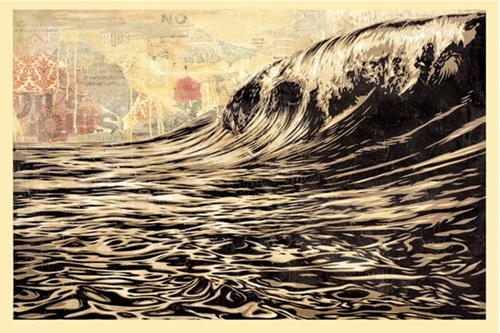
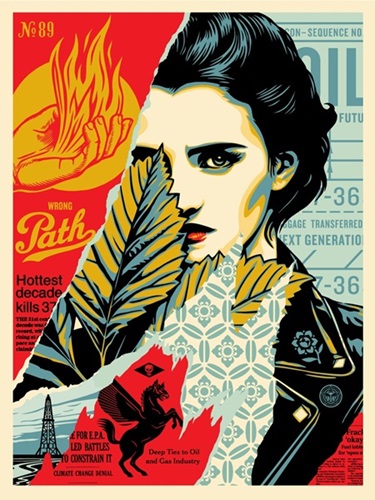
Fossil Factory belongs to Fairey's intense 2016-2017 run of environmental screen prints addressing oil, fossil fuels, and climate change. The work is distinctive for its concrete source, an illustration of a repurposed factory in Paris's 13th district, which Fairey turns into an argument for converting industrial relics into schools and redirecting subsidies toward renewable energy. The accompanying statement cites Naomi Klein's This Changes Everything and pledges proceeds to 350.org, situating the print within a documented climate-activism context. Within Fairey's arc it extends his long practice of issue-driven editions, sitting alongside Dark Wave, Wrong Path, and Drink Crude Oil as part of a tightly themed environmental body of work from this era.
FAQ
What is depicted in Fossil Factory?
It is an illustration based on a former factory in the 13th district of Paris that is now used for university classrooms. Fairey presents the monolithic industrial architecture as a reminder of what fossil-fuel-powered industry built, while arguing for converting such factories into schools and shifting subsidies toward renewable energy.
Is the print connected to a charity?
Yes. Per the release statement, a portion of the proceeds from the sale of this print goes to 350.org to support its efforts to fight climate change. Fairey also references Naomi Klein's book This Changes Everything to frame the conflict between economic interests and climate.
What are the dimensions, medium, and edition?
Fossil Factory is a screen print on cream Speckle Tone paper measuring 18 x 24 inches, signed by Shepard Fairey and issued in an edition of 450. It was published by Obey Giant in 2017 at an original price of $55.
How does Fossil Factory fit Fairey's body of work?
It is part of his concentrated 2016-2017 environmental output addressing oil, fossil fuels, and climate change. With its concrete architectural subject and explicit policy argument, it stands as one of the more directly argued environmental statements in that group of prints.
Related Works



About the Artist

Shepard Fairey (b. 1970, Charleston, South Carolina) is an American street artist, graphic designer, and activist, and a graduate of the Rhode Island School of Design. His 1989 “André the Giant Has a Posse” sticker grew into the global OBEY GIANT campaign — an ongoing experiment in propaganda, obedience, and visual culture. He reached worldwide recognition with the 2008 “Hope” portrait of Barack Obama, now held by the Smithsonian National Portrait Gallery. Across screen prints, stencils, murals, and collage, Fairey channels propaganda aesthetics toward themes of peace, justice, environmentalism, and civil rights. His work is in the collections of the Museum of Modern Art, the Victoria & Albert Museum, and LACMA.