Gauntlet Gallery
What is Shepard Fairey’s piece called “Dark Wave (Offset Poster)”?
Artist Statement
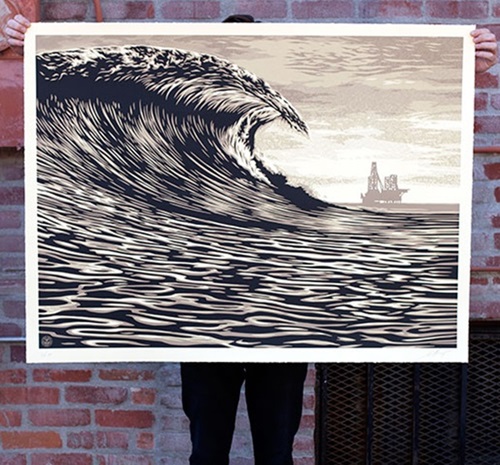
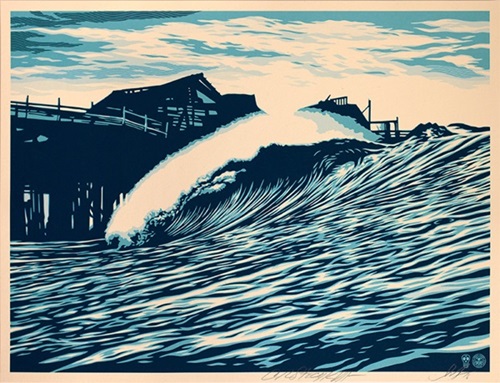
24 x 36 inches. Offset poster on thick cream Speckle Tone paper. Signed by Shepard Fairey. Open edition. I first illustrated the Dark Wave piece in 2010 as a response to the BP spill in the Gulf of Mexico. I made some fine art pieces of the image that I liked even more than the screen prints and decided I'd like to release an offset of the fine art version. I am releasing this both because I like the image, and because unfortunately, the environmental hazards of off-shore drilling are just as relevant today as they were in 2010…especially with the relaxed regulations under the new administration. I enjoy doing illustrations of water with its hypnotic ripples and reflections. There's oil in this water, which mixes ok in an illustration, but not so well in real life. I want future generations to inhabit a livable planet. – Shepard
Summary
Dark Wave (Offset Poster) is a 2017 Shepard Fairey offset lithograph on thick cream Speckle Tone paper, 24 x 36 inches, signed and issued as an open edition by Obey Giant. Fairey first illustrated the Dark Wave image in 2010 as a response to the BP spill in the Gulf of Mexico, later making fine-art versions he preferred to the screen prints; this poster reproduces that fine-art version. The image depicts hypnotic, rippling water laced with oil, carrying an environmental warning about off-shore drilling. Original price was $35.
Why It Matters
Dark Wave is a striking environmental image with a documented origin in the 2010 BP Gulf of Mexico oil spill, and this 2017 offset poster brings that imagery to a wider audience as an open edition. Fairey explains that he first illustrated Dark Wave in 2010 as a response to the spill, made fine-art versions he liked even more than the screen prints, and chose to release an offset of the fine-art version because the message of off-shore drilling's hazards remained relevant, citing relaxed regulations under the new administration. He notes his enjoyment of illustrating water with its hypnotic ripples and reflections, while pointing out that oil mixing into water works in an illustration but not in real life, and voices his wish for future generations to inhabit a livable planet. For collectors, the open-edition offset format makes a compelling Fairey environmental image accessible at a low entry price and in a larger 24 x 36 size, distinct from his numbered screen prints. It anchors his oil-and-water environmental imagery and connects to a lineage of wave-themed pieces, making it both an affordable statement print and a connective work within an environmentally focused collection.
Collector Perspective
Dark Wave appeals to collectors who want a strong Fairey environmental image at an accessible entry point, since the open-edition offset format and low original price make it approachable for newer buyers. Its larger 24 x 36 size gives it real wall presence, distinct from his standard 18 x 24 screen prints, and the hypnotic oil-laced water imagery reads beautifully when framed. It pairs naturally with his other wave and oil-themed works and serves as a connective piece in an environmentally focused collection. Collectors who prioritize image impact and affordability over edition scarcity will find it especially attractive, while those building a climate-themed set gain a visually distinctive anchor rooted in the documented BP spill response.
Historical Context
Dark Wave traces back to 2010, when Fairey first illustrated the image as a response to the BP oil spill in the Gulf of Mexico. He developed fine-art versions he preferred to the original screen prints, and in 2017 chose to release this offset poster of that fine-art version, noting that the hazards of off-shore drilling remained relevant amid relaxed regulations under the new administration. As an open-edition offset lithograph, it differs from his numbered screen prints and reflects his practice of reissuing potent environmental imagery in accessible formats. Within his arc, it sits among his 2016-2017 environmental works while carrying a longer history rooted in his ongoing response to oil and climate crises.
FAQ
What inspired Dark Wave?
Fairey states he first illustrated Dark Wave in 2010 as a response to the BP oil spill in the Gulf of Mexico. He later made fine-art versions he liked even more than the screen prints, and this 2017 offset poster reproduces that fine-art version.
Is this an open or numbered edition?
Dark Wave (Offset Poster) is an open edition, meaning it was not produced in a fixed numbered run. It is an offset lithograph signed by Shepard Fairey, published by Obey Giant in 2017 at an original price of $35.
What are the size and medium?
It is an offset poster, listed as an offset lithograph, printed on thick cream Speckle Tone paper and measuring 24 x 36 inches. That makes it larger than Fairey's standard 18 x 24 screen prints, giving it strong wall presence.
What does the image depict?
The image shows hypnotic, rippling water with oil in it, an environmental warning about the hazards of off-shore drilling. Fairey notes the oil mixes acceptably in an illustration but not in real life, and expresses his wish for future generations to inhabit a livable planet.
Related Works


About the Artist

Shepard Fairey (b. 1970, Charleston, South Carolina) is an American street artist, graphic designer, and activist, and a graduate of the Rhode Island School of Design. His 1989 “André the Giant Has a Posse” sticker grew into the global OBEY GIANT campaign — an ongoing experiment in propaganda, obedience, and visual culture. He reached worldwide recognition with the 2008 “Hope” portrait of Barack Obama, now held by the Smithsonian National Portrait Gallery. Across screen prints, stencils, murals, and collage, Fairey channels propaganda aesthetics toward themes of peace, justice, environmentalism, and civil rights. His work is in the collections of the Museum of Modern Art, the Victoria & Albert Museum, and LACMA.