Gauntlet Gallery
What is Shepard Fairey’s piece called “Factory”?
Artist Statement
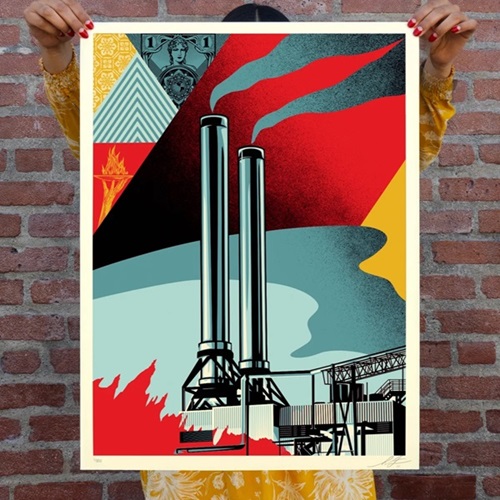
FACTORY Screen Print 18 x 24 inches Edition of 200
Summary
Factory is a 2000 Shepard Fairey screen print, published by Obey Giant in a first edition of 200, measuring 18 x 24 inches. The image centers on industrial subject matter, carrying both Fairey's pop-cultural graphic sensibility and an early environmental undertone tied to industry. Executed in his bold, high-contrast style, it sits within his early Obey Giant studio output. As one of 200 impressions, it has a moderately limited run for the period. The print prefigures Fairey's later, more explicit environmental works built around factories, smokestacks, and pollution imagery.
Why It Matters
Factory is notable for combining Shepard Fairey's early graphic vocabulary with an industrial, environmentally inflected subject—a thread that would become a sustained motif across his later career. Dated 2000 and published by Obey Giant in an edition of 200, it belongs to the formative studio period when Fairey was establishing the visual identity that underpins his mature work. The factory imagery anticipates a recurring environmental concern that recurs years later in works built around smokestacks, pollution, and industry. That continuity gives the print added significance in a knowledge graph: it is an early node connecting Fairey's pop-cultural roots to his ongoing critique of industrial impact on the environment. For collectors, this dual reading—pop-culture surface plus environmental undertone—makes Factory a more thematically rich early print than purely decorative stencils of the same year. Its edition of 200 is modest but slightly larger than several companion 2000 releases, balancing scarcity with availability. As a documentary artifact, Factory helps trace how an environmental sensibility threaded through Fairey's output long before it became a headline focus, linking turn-of-the-millennium studio work to his 2017 and 2022 factory and smokestack imagery.
Collector Perspective
Factory appeals to collectors interested in the environmental strand of Fairey's work as well as early Obey Giant completists. Its industrial subject and early environmental undertone make it a meaningful anchor for a thematic collection that traces Fairey's pollution and industry imagery across decades. At 18 x 24 inches with an edition of 200, it is accessible and frame-friendly, displaying well alongside both period stencils and later factory-themed prints. The bold graphic reads strongly on a wall. This print suits a buyer who values thematic continuity and wants an early example that connects Fairey's pop-cultural roots to his sustained environmental concerns, rather than purely decorative early work.
Historical Context
Factory dates to Shepard Fairey's early Obey Giant studio period around 2000, when his street practice was maturing into editioned screen prints. While many 2000 releases were primarily graphic or pop-cultural, Factory introduces an industrial subject with an environmental undertone—an interest Fairey would revisit far more explicitly in later years through smokestack, pollution, and factory imagery. This positions the print as an early marker of a theme that runs across his arc, well before his 2008 Obama breakthrough. It belongs to the cluster of turn-of-the-millennium Obey Giant editions, but its subject distinguishes it as a precursor to the environmental works that became prominent in his later catalog.
FAQ
What is the subject of Factory?
As the title indicates, the print centers on industrial/factory imagery. The source assigns it a secondary environmental theme alongside its pop-cultural primary theme, reflecting an early environmental undertone in Fairey's work.
When was it made and what is the edition size?
Factory is dated 2000, published by Obey Giant, in a first edition of 200 impressions according to the source. That is a modest run, slightly larger than several companion 2000 releases.
What are the dimensions and medium?
It is a screen print measuring 18 x 24 inches, per the source description, a frame-friendly format common across Fairey's editioned prints of the era.
How does it connect to Fairey's later work?
Its industrial subject anticipates Fairey's recurring environmental imagery, including later factory and smokestack prints, making it an early node in that thematic line within his catalog.
Related Works
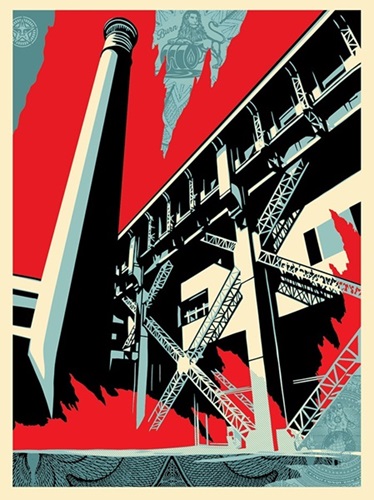
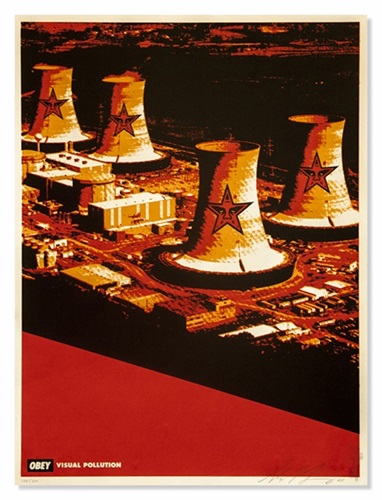


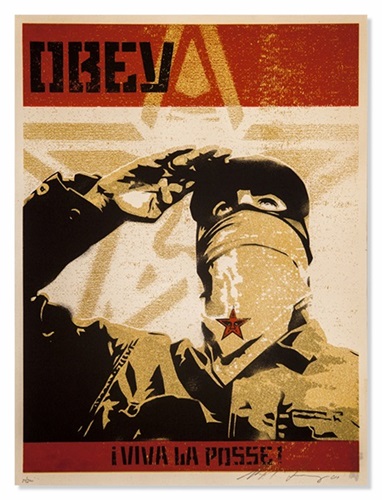
About the Artist

Shepard Fairey (b. 1970, Charleston, South Carolina) is an American street artist, graphic designer, and activist, and a graduate of the Rhode Island School of Design. His 1989 “André the Giant Has a Posse” sticker grew into the global OBEY GIANT campaign — an ongoing experiment in propaganda, obedience, and visual culture. He reached worldwide recognition with the 2008 “Hope” portrait of Barack Obama, now held by the Smithsonian National Portrait Gallery. Across screen prints, stencils, murals, and collage, Fairey channels propaganda aesthetics toward themes of peace, justice, environmentalism, and civil rights. His work is in the collections of the Museum of Modern Art, the Victoria & Albert Museum, and LACMA.