Gauntlet Gallery
What is Shepard Fairey’s piece called “Make Art Not War (Peace Girl) (Large Format)”?
Artist Statement
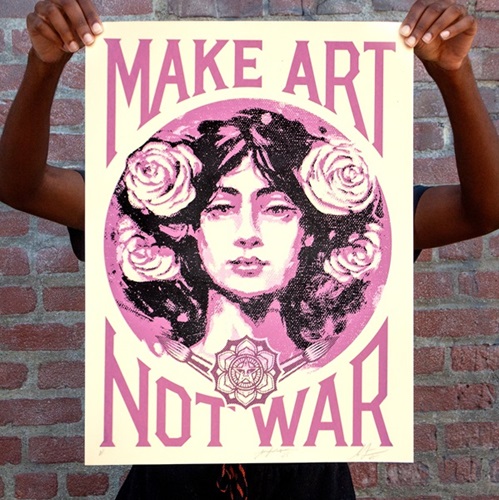
This print, created during the Iraq war, is an alternative phrase inspired by popular 1960s anti-war mantra, "Make love, not war." In this case, Fairey asserts the need for creative rather than destructive acts. The Art Nouveau style of the image is an additional reference to the influence of Art Nouveau on hippie and psychedelic art of the '60s, including many anti-Vietnam war posters. Encased within a floral garland, the female figure appears more self-assured and real rather than ethereal. The placement of two paintbrushes below her portrait not only refers to a classical tool of art production but resembles spears, which when read alongside the directive to "OBEY" that appears on her neck, simultaneously makes the otherwise palatable message more pointed. Make Art Not War. Serigraph on Coventry Rag, 100% Cotton Custom Archival Paper with hand-deckled edges. 30 x 41 inches. Signed by Shepard Fairey. Numbered edition of 89. Comes with a certificate of authenticity. $900.
Summary
Make Art Not War (Peace Girl) is a 2019 large-format screen print by Shepard Fairey, published by Obey Giant in a signed, numbered edition of 89, measuring 30 x 41 inches on Coventry Rag 100% cotton archival paper with hand-deckled edges. An Art Nouveau-styled female figure is encased within a floral garland, appearing self-assured and real rather than ethereal, with the word "OBEY" on her neck. Two paintbrushes placed below her portrait double as spears, sharpening the message. The phrase reworks the 1960s anti-war mantra "Make love, not war" to assert the need for creative rather than destructive acts.
Why It Matters
Make Art Not War (Peace Girl) distills Fairey's core ethos, that creativity is a constructive alternative to violence, into a single emblematic image. The phrase deliberately reworks the 1960s anti-war mantra "Make love, not war," and the Art Nouveau styling references that movement's influence on hippie and psychedelic art, including many anti-Vietnam war posters, anchoring the work in a recognizable lineage of protest aesthetics. Fairey adds his own edge: the female figure is rendered self-assured and grounded rather than purely decorative, and the two paintbrushes below her resemble spears, so that when read alongside the "OBEY" on her neck, the otherwise palatable message becomes more pointed. This tension between beauty and bite is what distinguishes the piece from straightforward decoration. As a slogan that doubles as a statement of Fairey's own practice, the title makes the print a kind of artist's manifesto. Released as a signed, numbered large-format edition of 89 on hand-deckled cotton rag, it offers fine-print presentation and relative scarcity, and connects to a recurring "Make Art Not War" motif Fairey has revisited across editions and years.
Collector Perspective
This print appeals to collectors who respond to Fairey's most quotable, manifesto-like messaging and to his floral, Art Nouveau-influenced portraiture. The self-assured female figure within a floral garland gives it strong decorative and statement appeal, displaying well as a portrait centerpiece at 30 x 41 inches on hand-deckled cotton rag. Because Fairey has revisited the "Make Art Not War" motif across editions and years, this large-format version fits collections built around that recurring image as well as collections organized around peace, anti-war, and floral themes. The numbered edition of 89 places it among his more limited large-format releases, appealing to collectors who prioritize lower edition sizes.
Historical Context
Make Art Not War (Peace Girl) belongs to Fairey's anti-war work created during the Iraq war, reworking the 1960s "Make love, not war" mantra into a call for creative rather than destructive acts. Its Art Nouveau styling consciously references that movement's influence on 1960s hippie, psychedelic, and anti-Vietnam war poster art, situating the piece within a lineage of protest aesthetics. The "Make Art Not War" phrase recurs across Fairey's catalog over multiple years and editions. This 2019 large-format release, a signed, numbered screen print of 89, reflects his later practice of issuing such recurring imagery at scale on premium archival paper, extending his fusion of decorative portraiture and anti-war messaging.
FAQ
What is the meaning of the title?
Per the source, "Make Art Not War" reworks the 1960s anti-war mantra "Make love, not war." Fairey uses it to assert the need for creative rather than destructive acts, making the slogan double as a statement of his own artistic practice.
Why is the style Art Nouveau?
The Art Nouveau style references that movement's influence on 1960s hippie and psychedelic art, including many anti-Vietnam war posters. The female figure sits within a floral garland and appears self-assured and real rather than ethereal.
What do the paintbrushes signify?
Two paintbrushes placed below the portrait refer to a classical tool of art production but also resemble spears. Read alongside the "OBEY" on her neck, they make the otherwise palatable message more pointed, per the source.
What are the edition details?
It is a numbered edition of 89, signed by Shepard Fairey and published by Obey Giant in 2019, with a certificate of authenticity. The large-format screen print measures 30 x 41 inches and was released at $900.
Related Works
About the Artist
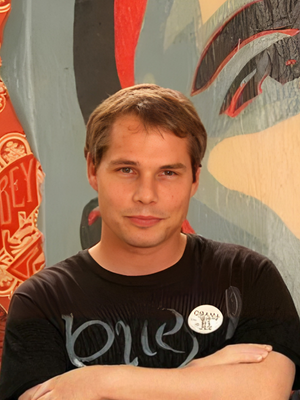
Shepard Fairey (b. 1970, Charleston, South Carolina) is an American street artist, graphic designer, and activist, and a graduate of the Rhode Island School of Design. His 1989 “André the Giant Has a Posse” sticker grew into the global OBEY GIANT campaign — an ongoing experiment in propaganda, obedience, and visual culture. He reached worldwide recognition with the 2008 “Hope” portrait of Barack Obama, now held by the Smithsonian National Portrait Gallery. Across screen prints, stencils, murals, and collage, Fairey channels propaganda aesthetics toward themes of peace, justice, environmentalism, and civil rights. His work is in the collections of the Museum of Modern Art, the Victoria & Albert Museum, and LACMA.