Gauntlet Gallery
What is Shepard Fairey’s piece called “Mao Money (Large Format)”?
Artist Statement
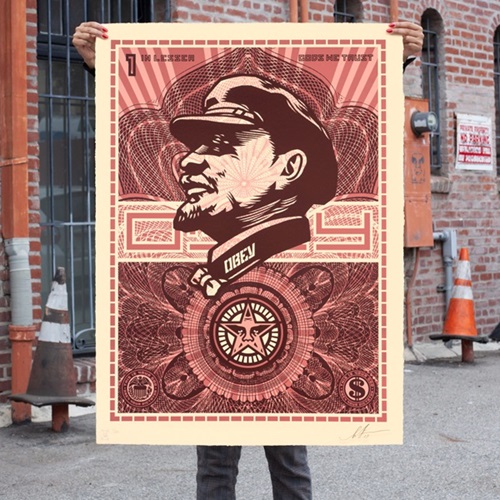
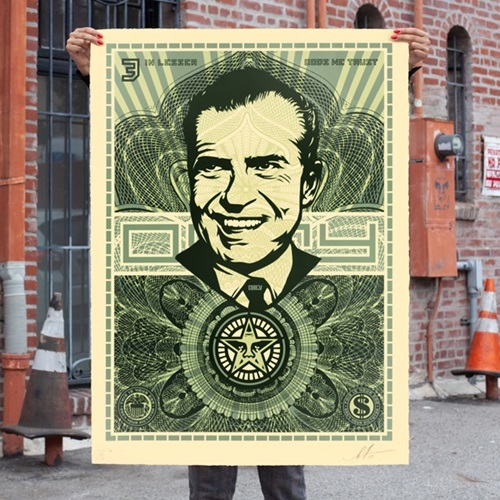
In 2003, Fairey dissected the graphic design of instruments of wealth and power such as currency, stamps, and stock certificates, resulting in a series of works about the intersection of economic wealth and political power. The minting of new currency featuring the portrait of the leader is an act characteristic of totalitarian regime. The numbered portraits of the infamous leaders 1) Lenin, 2) Mao, and 3) Nixon are surrounded by design elements commonly used for such documents, including ornate patterns and intricate motifs incorporated to confound counterfeiters. The artist inserts his own imagery including the Obey Star Icon and the word "Obey" into the composition. "In lesser gods we trust," is a recurring phrase used by the artist. It is an alteration of "In God we trust" phrase used by the artist. It is an alteration of "In God we trust" found on the back of all US currency, signaling the contradicting term given that the separation of church and state is a founding principle of the constitution. Fairey's use of the term refers to the process of deification of powerful leaders and the corresponding betrayal of public trust through corruption and abuse of power. The combination of the foreign leaders and a US President is intended to remind the viewer that we must not only look outside our nation for those who abuse powers but must be vigilant in our own country as well. Although these works were made during the Bush administration, in the current tumultuous political climate of the Trump administration, the message is more important than ever. The portraits are a cautionary reminder, urging the public to question authority and be properly informed. Reminding us that truth and power cannot be reconciled. Those who want to control society will inevitably create fictitious narratives to do so. – Description written by co-curator Pedro Alonzo.? Lesser Gods Lenin, Lesser Gods Mao, and Lesser Gods Nixon SOLD AS A MATCHING NUMBERED SET for $2,000. Remaining inventory sold individually at $900 each. Serigraph on Coventry Rag, 100% Cotton Custom Archival Paper with hand-deckled edges. 30 x 41 inches. Signed by Shepard Fairey. Numbered edition of 89. Comes with a certificate of authenticity.
Summary
Mao Money (Large Format) is a 2019 Shepard Fairey screen print, published by Obey Giant in a signed, numbered first edition of 89, measuring 30 x 41 inches on Coventry Rag archival cotton paper with hand-deckled edges. It renders Mao Zedong in the style of printed currency, framing his portrait with ornate patterns and intricate anti-counterfeit motifs drawn from banknotes, stamps, and stock certificates. Fairey inserts his Obey Star icon, the word "Obey," and the recurring phrase "In lesser gods we trust," an alteration of "In God we trust." The large-format work treats a foreign leader as minted currency to interrogate the deification of powerful figures and the abuse of power.
Why It Matters
Mao Money is part of Fairey's "Lesser Gods" currency series, where he dissects the graphic design of money, stamps, and stock certificates to expose how economic wealth and political power reinforce one another. Casting Mao as printed currency links the minting of a leader's portrait to the visual habits of totalitarian regimes, where issuing money bearing a ruler's face becomes an instrument of control. The altered motto "In lesser gods we trust" frames the deification of powerful figures as a betrayal of public trust through corruption and the abuse of power. Co-curator Pedro Alonzo's text notes the works originated under the Bush administration yet gained renewed urgency in later political climates, serving as a cautionary reminder to question authority and remain informed. Within the matched trio of Lenin, Mao, and Nixon, Fairey deliberately pairs foreign leaders with a U.S. president to argue that the abuse of power must be watched for at home as well as abroad. The signed, numbered large-format edition of 89, with its certificate of authenticity, offers collectors a monumental statement at the intersection of money, propaganda, and Obey iconography.
Collector Perspective
Mao Money draws collectors who favor Fairey's explicitly political work and his recurring study of currency, propaganda, and the design of power. At 30 x 41 inches it reads as a bold, monumental wall piece, the dense banknote ornamentation rewarding close inspection while the central portrait carries across a room. It pairs naturally with the Lenin and Nixon currency prints, originally offered as a matching numbered set, so completists can pursue cross-print numbering. The small first edition of 89, signed and numbered with a certificate of authenticity, gives it appeal for buyers who weight scarcity and message. It slots cleanly into a collection organized around Fairey's critiques of power, money, and Obey iconography.
Historical Context
Mao Money grows out of Fairey's 2003 investigation into the graphic design of instruments of wealth and power, including currency, stamps, and stock certificates, a body of work about economic wealth and political power. The 2019 large-format edition restates that idea at monumental scale during the "Facing the Giant: Three Decades of Dissent" period marking Obey Giant's thirtieth anniversary. Pedro Alonzo's description positions the work as art made under the Bush administration whose warning felt renewed in the Trump era. The Obey Star and the word "Obey" tie this currency critique to Fairey's larger iconographic vocabulary, and the pairing of Mao with Lenin and Nixon reflects his recurring strategy of mixing foreign and domestic leaders to broaden the political indictment.
FAQ
What is the edition size of Mao Money (Large Format)?
It is a numbered first edition of 89, signed by Shepard Fairey and accompanied by a certificate of authenticity. The large-format version was published by Obey Giant in 2019 and measures 30 x 41 inches.
What material is it printed on?
It is a serigraph (screen print) on Coventry Rag, a 100% cotton custom archival paper with hand-deckled edges. The sheet measures 30 x 41 inches, placing it among Fairey's large-format prints.
What is the meaning behind the currency styling?
Fairey treats a leader's portrait like minted currency, surrounding it with ornate anti-counterfeit motifs from banknotes and stock certificates. The minting of new currency featuring a leader's face is presented as characteristic of totalitarian regimes and the deification of power.
Does Mao Money come as part of a set?
Yes. It is one of three currency portraits with Lenin and Nixon. Per the release, the three were sold as a matching numbered set for $2,000, while remaining inventory was sold individually at $900 each.
Related Works
About the Artist

Shepard Fairey (b. 1970, Charleston, South Carolina) is an American street artist, graphic designer, and activist, and a graduate of the Rhode Island School of Design. His 1989 “André the Giant Has a Posse” sticker grew into the global OBEY GIANT campaign — an ongoing experiment in propaganda, obedience, and visual culture. He reached worldwide recognition with the 2008 “Hope” portrait of Barack Obama, now held by the Smithsonian National Portrait Gallery. Across screen prints, stencils, murals, and collage, Fairey channels propaganda aesthetics toward themes of peace, justice, environmentalism, and civil rights. His work is in the collections of the Museum of Modern Art, the Victoria & Albert Museum, and LACMA.