Gauntlet Gallery
What is Shepard Fairey’s piece called “O.G. Rips”?
Artist Statement
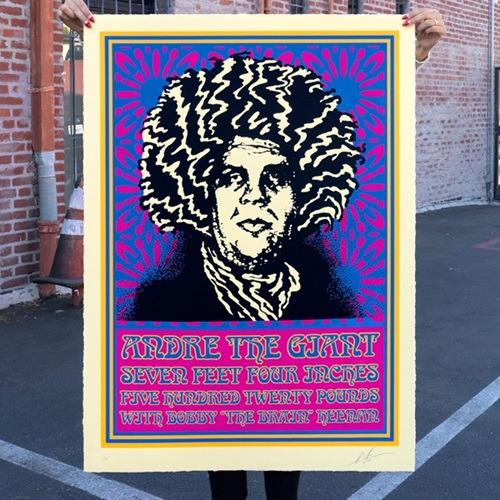
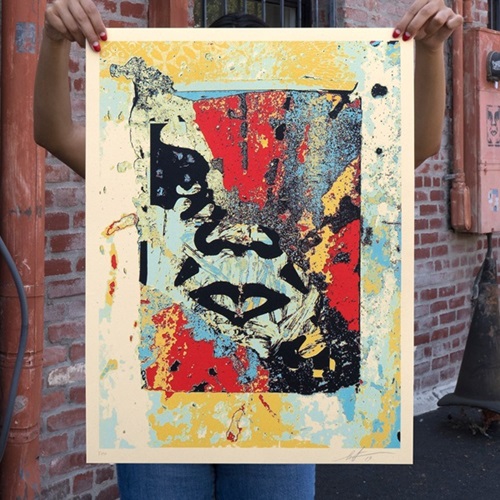
O.G. Rips. Serigraph on Coventry Rag, 100% Cotton Custom Archival Paper with hand-deckled edges. 30 x 41 inches. Signed by Shepard Fairey. Numbered edition of 89. Comes with a certificate of authenticity. $900. The immediate success and proliferation of the Andre sticker compelled Fairey to develop strategies to expand the reach of his campaign and call attention to the original sticker in public space. However, he did want to alter the design, as a means to diversify the Andre sticker from the original black and white image. He began to print stickers with the same illustration and text but with animal patterns and colorful Op art backgrounds. His desire to create attention-getting color combinations resulted in extensive research into psychedelic posters from the late 1960s. Fairey was particularly drawn to the aggressive color combinations of posters made for the legendary San Francisco music venue, The Filmore. Up until the creation of "Andre Psychedelic," Shepard's dedication to the Andre sticker, and its corresponding success made him wary of incorporating Andre into other works of art. Fairey's love of psychedelic posters in general and his deep admiration for John Van Hamersveld's 1968 image of Jimmy Hendrix allowed him to insert Andre's face, taken from the original sticker, into a psychedelic design. This initial stylistic breakthrough would become a fundamental strategy throughout Fairey's artistic practice. The image would become the first fine art screenprint featuring Fairey's version of the wrestler's face. The Andre sticker, which Fairey created as a student in 1989, is the cornerstone of his 30-year practice. The artist uses a cropped image of the original sticker to reflect on three decades of evolution in his work and dramatic shifts in society. Fairey's career started with placing stickers in public space, an intentionally ambiguous statement, that over decades transformed into an overtly political, message-driven practice. Fairey inserts colors, rips, and patterns reminiscent of psychedelic imagery onto and around the iconic face. The disorienting design addresses the dramatic shift from analog forms of disseminating information to the current digital bombardment of imagery and information online. Fairey ages the iconic face by covering it with colored lines and tears, signifying years of work put in by the artist to establish himself by placing work in public space, a realm loaded with competing messages and the threat of arrest. The layers and rips are also a bod to the ephemeral nature of street art. For 30 years Fairey has placed his art in the urban landscape, which has been removed by property owners, civil servants, eroded by Mother Nature, and covered by other artists.
Summary
O.G. Rips is a 2019 Shepard Fairey serigraph on Coventry Rag 100% cotton archival paper with hand-deckled edges, 30 x 41 inches, in a signed, numbered edition of 89 with a certificate of authenticity. The work crops Fairey's iconic Andre the Giant face and overlays it with colored lines, rips, and psychedelic-inflected patterns. Marking three decades of the Andre image, the disorienting design ages the face to evoke the artist's years of public-space work and the ephemeral, weathered fate of street art exposed to removal, the elements, and competing imagery.
Why It Matters
O.G. Rips is a reflective, self-referential work that turns Fairey's foundational OBEY iconography into a meditation on his own thirty-year arc. The source explains that the Andre sticker, created when Fairey was a student in 1989, is the cornerstone of his practice; here he crops that original image and covers it with rips and colored lines to signify decades of labor placing work in public space under the constant threat of removal and arrest. The design also addresses a cultural shift, from analog information dissemination to the digital bombardment of images online, layering meaning onto the familiar face. For collectors this is among the more conceptually loaded Andre treatments, and its production values reinforce its significance: a serigraph on 100% cotton Coventry Rag with hand-deckled edges, a large 30 x 41 inch format, and a tightly limited edition of 89 with a certificate of authenticity. It functions both as a celebration and a critique of icon-making, making it a substantive anchor piece within the OBEY catalog rather than a simple logo reissue.
Collector Perspective
This is a piece for serious OBEY and Fairey collectors who prize the Andre iconography and want a large, archival, statement work. The 30 x 41 inch scale and hand-deckled Coventry Rag paper give it gallery presence, and the certificate of authenticity plus tight edition of 89 make it a centerpiece rather than a fill print. Its self-referential narrative, marking thirty years of the Andre image with rips and psychedelic layers, gives it intellectual appeal for collectors who value concept alongside aesthetics. It fits naturally into an OBEY Icon collection or as the focal work in a Fairey grouping, and pairs especially well with the Andre Psychedelic large format it shares production with.
Historical Context
The Andre sticker, made by Fairey as a student in 1989, became the foundation of his entire practice, evolving from intentionally ambiguous street stickers into an overtly political, message-driven body of work. O.G. Rips, released in 2019, looks back across that thirty-year span. The source ties it to Fairey's early experiments diversifying the Andre image with animal patterns and Op art backgrounds and his research into late-1960s San Francisco psychedelic posters from venues like the Fillmore, including admiration for John Van Hamersveld's 1968 Hendrix image. By aging and tearing the iconic face, the print embodies the ephemeral nature of street art and Fairey's decades of public-space work, positioning it as a mature, retrospective statement within his OBEY iconography.
FAQ
What is O.G. Rips?
O.G. Rips is a 2019 Shepard Fairey serigraph that crops the iconic Andre the Giant face and overlays it with colored lines, rips, and psychedelic patterns. It is printed on Coventry Rag 100% cotton archival paper with hand-deckled edges at 30 x 41 inches.
How large is the edition?
According to the source, it is a signed, numbered edition of 89 and comes with a certificate of authenticity.
What does the imagery mean?
Fairey uses the cropped Andre image, the cornerstone of his practice since the 1989 sticker, to reflect on thirty years of his work. The rips and layers signify years of public-space labor and the ephemeral nature of street art, which is removed, weathered, and covered over time.
What paper and size is it?
It is a serigraph on Coventry Rag 100% cotton custom archival paper with hand-deckled edges, measuring 30 x 41 inches, signed by Shepard Fairey.
Related Works
About the Artist

Shepard Fairey (b. 1970, Charleston, South Carolina) is an American street artist, graphic designer, and activist, and a graduate of the Rhode Island School of Design. His 1989 “André the Giant Has a Posse” sticker grew into the global OBEY GIANT campaign — an ongoing experiment in propaganda, obedience, and visual culture. He reached worldwide recognition with the 2008 “Hope” portrait of Barack Obama, now held by the Smithsonian National Portrait Gallery. Across screen prints, stencils, murals, and collage, Fairey channels propaganda aesthetics toward themes of peace, justice, environmentalism, and civil rights. His work is in the collections of the Museum of Modern Art, the Victoria & Albert Museum, and LACMA.