Gauntlet Gallery
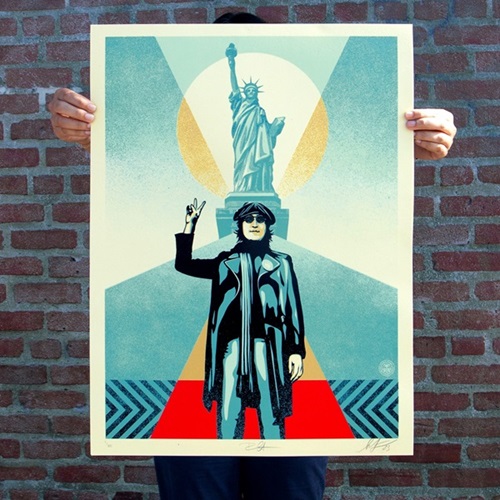
What is Shepard Fairey’s piece called “Obey Radical Peace (Blue)”?
Artist Statement
OBEY RADICAL PEACE (three colorways: Blue, Red, & Cream). A limited number of matching numbered sets will be available for $165. Blue, Red, & Cream sold separately for $55. 18 x 24 inches. Screen print on thick cream Speckletone paper. Signed by Shepard Fairey. Numbered edition of 375. $55. Proceeds go to Defending Rights & Dissent. Here's a new screen print that is based on an art piece from my "Future Mosaic" art show. My philosophy has always been that violence is the first resort of the weak-minded. The January 6th attack on the Capitol was the inspiration for this image but, unfortunately, there are plenty of other examples of small-minded violence. I would like to see people use diplomacy and creativity to find mutually beneficial solutions to problems rather than using violence as the first reaction to conflict.? Proceeds go to Defending Rights and Dissent to support their efforts on strengthening our participatory democracy by protecting the right to political expression. –Shepard
Summary
Obey Radical Peace (Blue) is a 2021 screen print, 18 x 24 inches on thick cream Speckletone paper, in a signed, numbered edition of 375, published by Obey Giant. Issued in Blue (also released in Red and Cream) at an original price of $55, it is based on a piece from Fairey's Future Mosaic art show. He frames it around his philosophy that violence is the first resort of the weak-minded, citing the January 6th attack on the Capitol as inspiration, and calls for diplomacy and creativity over violence. A percentage of proceeds went to Defending Rights & Dissent. Matching numbered sets of all three colorways were offered for $165.
Why It Matters
Obey Radical Peace ties Fairey's long-standing peace advocacy to a specific, charged event: the January 6th attack on the U.S. Capitol, which he names as the image's inspiration. By pairing the word peace with radical, the print reframes nonviolence not as passivity but as a deliberate, assertive stance, consistent with his stated philosophy that violence is the first resort of the weak-minded. Its origin in his Future Mosaic art show connects it to his broader exhibition work, while its call for diplomacy and creativity in resolving conflict gives it a constructive rather than purely oppositional message. The decision to direct proceeds to Defending Rights & Dissent, an organization focused on protecting the right to political expression, reinforces the civic stakes Fairey attaches to the piece. For collectors, it is a politically grounded screen print that documents an artist's direct response to a pivotal moment in recent American history, available in three coordinated colorways that invite set collecting. It exemplifies how Fairey channels current events into accessible, cause-linked editions.
Collector Perspective
This print appeals to collectors focused on Fairey's peace and political work, and to those who appreciate editions tied to specific historical events like January 6th. The 18 x 24 format and three coordinated colorways, Blue, Red, and Cream, make it attractive for set collectors pursuing the matching numbered sets. Its association with Defending Rights & Dissent gives it a clear civic narrative for values-led collections, and its origin in the Future Mosaic show adds exhibition provenance interest. At an edition of 375 per colorway and a $55 original release price, it is an accessible signed and numbered piece. Collectors assembling a peace, anti-violence, or 2021 political grouping of Fairey prints will find it a coherent and meaningful addition.
Historical Context
Released in May 2021, Obey Radical Peace responds directly to the January 6th, 2021 attack on the U.S. Capitol, placing it among Fairey's timely reactions to contemporary American political events. It is drawn from his Future Mosaic art show, linking the print to his exhibition practice, and it advances his consistent anti-violence philosophy that diplomacy and creativity should precede force. The proceeds to Defending Rights & Dissent connect it to his pattern of pairing releases with organizations defending civil liberties and political expression. Issued in three colorways with matching-set availability, it reflects his established practice of offering variant editions during this prolific activist period of his career.
FAQ
What inspired this image?
Fairey cites the January 6th attack on the U.S. Capitol as the inspiration, though he notes there are plenty of other examples of small-minded violence. The print reflects his philosophy that violence is the first resort of the weak-minded and his preference for diplomacy and creativity over violent reactions to conflict.
What are the dimensions and edition size?
Obey Radical Peace (Blue) measures 18 x 24 inches and is a screen print on thick cream Speckletone paper. It is signed by Shepard Fairey and numbered in an edition of 375 per colorway, published by Obey Giant in 2021, with an original release price of $55.
Were there other colorways or sets available?
Yes. The print was released in three colorways, Blue, Red, and Cream, each sold separately for $55. A limited number of matching numbered sets of all three colorways were offered for $165.
Did this release support a cause?
Yes. A percentage of proceeds went to Defending Rights & Dissent, which works to strengthen participatory democracy by protecting the right to political expression. The image itself is based on a piece from Fairey's Future Mosaic art show.
Related Works

About the Artist

Shepard Fairey (b. 1970, Charleston, South Carolina) is an American street artist, graphic designer, and activist, and a graduate of the Rhode Island School of Design. His 1989 “André the Giant Has a Posse” sticker grew into the global OBEY GIANT campaign — an ongoing experiment in propaganda, obedience, and visual culture. He reached worldwide recognition with the 2008 “Hope” portrait of Barack Obama, now held by the Smithsonian National Portrait Gallery. Across screen prints, stencils, murals, and collage, Fairey channels propaganda aesthetics toward themes of peace, justice, environmentalism, and civil rights. His work is in the collections of the Museum of Modern Art, the Victoria & Albert Museum, and LACMA.