Gauntlet Gallery
What is Shepard Fairey’s piece called “Obey Shadowplay (Offset Lithograph)”?
Artist Statement
This Shadowplay print is inspired by punk, post-punk, and new wave music graphics that combined original art and found imagery in subversive and enigmatic ways. I love that a lot of those graphics are technically crude yet visually sophisticated. That kind of art inspired my earliest high school experiments with a copy machine, x-acto knife, and stencils. Shadowplay is a reference to the shadows of the face in my pop-noir image, but also to Joy Division and their graphic designer, Peter Saville, who crafted their beautiful and haunting covers from found and manipulated imagery. Coincidentally 45 years ago today, Joy Division marked their television debut with a performance of "Shadowplay" on Granada Reports. Check out Joy Division's music and Saville's design if you are unfamiliar. –Shepard Shadowplay. 24 x 36 inches. Offset on thick cream Speckletone paper. Signed by Shepard Fairey. $35
Summary
Obey Shadowplay (Offset Lithograph) is a 2023 Obey Giant print, 24 x 36 inches on thick cream Speckletone paper, signed by Shepard Fairey. The source lists the Blue colorway among several (Blue, Offset Lithograph, Orange, Paris Colourway). The image is a pop-noir face built from shadow, inspired by punk, post-punk, and new wave music graphics that combined original and found imagery. Shadowplay references both the shadows in the face and Joy Division and their designer Peter Saville, noting the band's debut television performance of Shadowplay 45 years earlier. It was offered at $35; edition is unnumbered in the source.
Why It Matters
Shadowplay is a music-rooted graphic that traces Fairey's own origins as an artist. The source connects it directly to the punk, post-punk, and new wave design tradition, technically crude yet visually sophisticated, that inspired his earliest high-school experiments with a copy machine, X-acto knife, and stencils. By naming Joy Division and their designer Peter Saville, and noting the 45th anniversary of the band's televised Shadowplay performance, Fairey grounds the print in a specific musical and design lineage that shaped his aesthetic. The pop-noir face built from shadow ties the title to both its visual concept and that homage. For collectors, the appeal is twofold: a music-and-counterculture subject and a window into the design heritage behind Fairey's style. Its larger 24 x 36 inch scale and multiple colorways, including a Paris Colourway, give collectors options and a sizeable display piece, while the accessible $35 release price broadens its reach. It rewards buyers who value the connections between Fairey, punk culture, and the album-cover design tradition, and who appreciate work that is explicitly self-referential about his formative influences.
Collector Perspective
This print appeals to music and counterculture collectors, Joy Division and post-punk fans, and admirers of Peter Saville's design legacy. The multiple colorways, Blue, Orange, and a Paris Colourway, give collectors choice and a path toward assembling a set. At 24 x 36 inches it offers strong wall presence as a graphic statement, and the $35 release price makes it broadly accessible. It fits naturally into a music-themed grouping and into collections that emphasize Fairey's punk roots and his connection to album-cover design history. Because it is offset and unnumbered in the source, it suits buyers prioritizing imagery, scale, and theme over scarcity.
Historical Context
Shadowplay reaches back to the punk, post-punk, and new wave graphic tradition that the source credits as foundational to Fairey's development, linking his current practice to his teenage experiments with copy machines, stencils, and X-acto knives. The explicit references to Joy Division and Peter Saville place it within his ongoing homage to the designers and bands that shaped his visual language. Released in 2023 across several colorways, it sits in the music-and-counterculture strand of his catalog and in his pop-noir treatment of musical icons. The work serves as a self-aware nod to the design heritage underpinning his entire body of OBEY imagery.
FAQ
What inspired Shadowplay?
The source says it is inspired by punk, post-punk, and new wave music graphics that combined original art and found imagery in subversive, enigmatic ways. Fairey notes that kind of art inspired his earliest high-school experiments with a copy machine, X-acto knife, and stencils.
Why is it called Shadowplay?
Per the source, the title refers both to the shadows of the face in Fairey's pop-noir image and to Joy Division and their graphic designer Peter Saville. Fairey notes the print coincided with the 45th anniversary of Joy Division's televised Shadowplay performance on Granada Reports.
What colorways exist?
The source lists several editions: Blue, an Offset Lithograph, Orange, and a Paris Colourway. This entry is the Blue colorway. The print is a 24 x 36 inch offset on thick cream Speckletone paper, signed by Shepard Fairey.
What were the price and size?
According to the source, Shadowplay measures 24 x 36 inches and was offered at $35. It is an offset print on thick cream Speckletone paper and is signed by Shepard Fairey.
Related Works
About the Artist
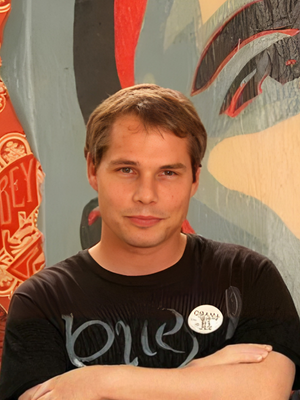
Shepard Fairey (b. 1970, Charleston, South Carolina) is an American street artist, graphic designer, and activist, and a graduate of the Rhode Island School of Design. His 1989 “André the Giant Has a Posse” sticker grew into the global OBEY GIANT campaign — an ongoing experiment in propaganda, obedience, and visual culture. He reached worldwide recognition with the 2008 “Hope” portrait of Barack Obama, now held by the Smithsonian National Portrait Gallery. Across screen prints, stencils, murals, and collage, Fairey channels propaganda aesthetics toward themes of peace, justice, environmentalism, and civil rights. His work is in the collections of the Museum of Modern Art, the Victoria & Albert Museum, and LACMA.