Gauntlet Gallery
What is Shepard Fairey’s piece called “Peace & Freedom”?
Artist Statement
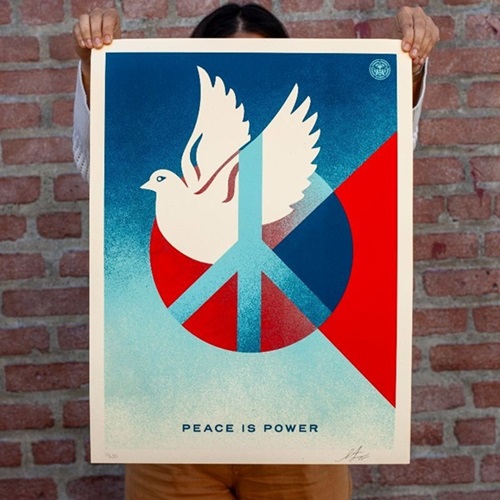
This Peace and Freedom print is a new take on symbols and themes that have been consistent in my art for several years. The text and imagery speak for themselves, but basically, the image is about cultivating peace and harmony to promote compassionate bonds with each other and break free from the invisible chains of division. Solidarity is required to reach critical mass for justice, and the purveyors of injustice sew division to avoid repercussions for their actions. Let's work together to push forward justice for all! -Shepard Peace and Freedom. 18 x 24 inches. Screen print on thick cream Speckletone paper. Signed by Shepard Fairey. Numbered edition of 300. Comes with a Digital Certificate of Authenticity provided by Verisart. $55.
Summary
Peace & Freedom is a 2024 screen print on thick cream Speckletone paper, 18 x 24 inches, signed by Shepard Fairey in a numbered edition of 300, published by Obey Giant. Fairey describes it as a new take on symbols and themes consistent in his art for several years, with imagery about cultivating peace and harmony to promote compassionate bonds and break free from the invisible chains of division. His statement argues that solidarity is required to reach critical mass for justice, and that purveyors of injustice sow division to avoid repercussions. The work calls for working together to advance justice for all.
Why It Matters
Peace & Freedom distills Fairey's recurring peace, harmony, and solidarity themes into a single image, framing division as a deliberate tool of injustice and unity as the path to justice. Its value lies in how cleanly it represents the message-driven core of his practice: the statement is direct and thematic rather than tied to a specific event, making it a clear, evergreen expression of ideas he has returned to for years. The combination of text and symbolic imagery places it within his propaganda-influenced graphic tradition, where slogans and icons carry the argument. At an edition of 300, it is more limited than many of his 550-run prints, which can modestly heighten collector interest. As a signed Obey Giant screen print at an accessible price, it was positioned for broad reach among collectors of his peace iconography. For a Fairey database, it anchors a grouping of his peace-and-justice releases and connects to a deep family of related dove, peace, and solidarity works in his catalog. It appeals to collectors who want a representative statement of his core humanist message rather than a topical, event-specific piece.
Collector Perspective
This print suits collectors building a peace-and-justice or solidarity-themed Fairey grouping and those who favor his evergreen humanist messaging over topical pieces. The 18 x 24 format on cream Speckletone paper frames easily and pairs well with his dove and peace works, and the signed, numbered edition of 300 with a Verisart certificate supports authenticity while offering slightly more scarcity than his 550-run prints. Its direct text-and-symbol composition makes the message legible at a glance, appealing to buyers who want a clear statement piece. At its accessible release price it reads as an approachable acquisition rather than a trophy, fitting collectors who prioritize thematic representativeness and display impact within a coherent peace-focused collection.
Historical Context
Peace & Freedom continues Fairey's long-running engagement with peace, harmony, and solidarity, themes he notes have been consistent in his art for several years. Rather than responding to a single event, it restates his core humanist argument that division is engineered by purveyors of injustice and that solidarity is the route to justice for all. Its text-and-symbol approach reflects the propaganda-influenced graphic language that has defined his work since his street-art roots. Released as a signed Obey Giant screen print in 2024 at an edition of 300, it sits within the broad family of peace and dove imagery he has produced across his career. Within his arc, it represents the steady, message-centered backbone of his catalog during the mid-2020s, distinct from his more event-specific political and environmental editions.
FAQ
What is the message of Peace & Freedom?
Fairey describes it as about cultivating peace and harmony to promote compassionate bonds and break free from the invisible chains of division. He argues that solidarity is required to reach critical mass for justice and that purveyors of injustice sow division to avoid repercussions.
What are the print's specifications?
It is a screen print on thick cream Speckletone paper measuring 18 x 24 inches, signed by Shepard Fairey in a numbered edition of 300. Published by Obey Giant in 2024, it comes with a Digital Certificate of Authenticity provided by Verisart.
Is this a topical or evergreen piece?
Fairey frames it as a new take on symbols and themes that have been consistent in his art for several years, rather than a response to a single event, making it a representative evergreen statement of his peace-and-justice message.
How does it relate to Fairey's other peace works?
It draws on the peace, harmony, and solidarity imagery that recurs throughout his catalog, connecting to his broader family of dove and peace prints while restating his humanist call to work together to advance justice for all.
Related Works

About the Artist

Shepard Fairey (b. 1970, Charleston, South Carolina) is an American street artist, graphic designer, and activist, and a graduate of the Rhode Island School of Design. His 1989 “André the Giant Has a Posse” sticker grew into the global OBEY GIANT campaign — an ongoing experiment in propaganda, obedience, and visual culture. He reached worldwide recognition with the 2008 “Hope” portrait of Barack Obama, now held by the Smithsonian National Portrait Gallery. Across screen prints, stencils, murals, and collage, Fairey channels propaganda aesthetics toward themes of peace, justice, environmentalism, and civil rights. His work is in the collections of the Museum of Modern Art, the Victoria & Albert Museum, and LACMA.