Gauntlet Gallery
What is Shepard Fairey’s piece called “Barb Wire Dove Screenprint (Gradient)”?
Artist Statement
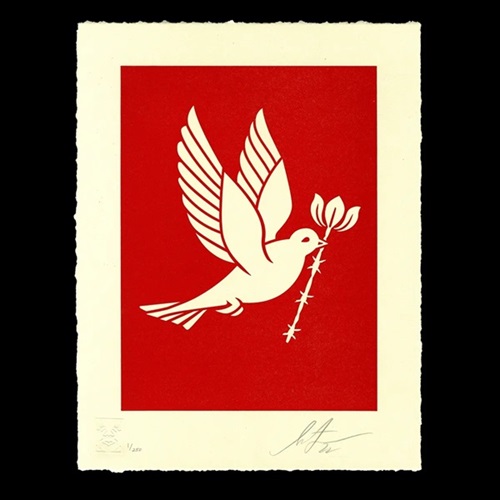
This Barb Wire Dove Gradient screen print is based on the Peace Dove, a motif I've used in several iterations over the years, because as an icon, the dove is internationally recognized as a symbol of peace, making it ideal as a communication tool. With the wars going on in the world, a message of peace is more important now than ever. The peace dove includes a flower growing from the barb wire, symbolizing positive growth from an oppressive situation. In this version of the Barb Wire Dove, I've explored a new color and placement by having the gradient of red with spray texture into the blue rays up toward what could be interpreted as the sky to depict the dove rising above the darkness and into a more positive future. Thanks as always for your support. - Shepard PRINT DETAILS:?Barb Wire Dove Gradient. 18 x 24. Screen print on 80# cream Speckletone paper. Signed by Shepard Fairey. Numbered edition of 275. Comes with a Digital Certificate of Authenticity provided by Verisart. $65
Summary
Barb Wire Dove Screenprint (Gradient) is a 2024 Shepard Fairey screen print published by Obey Giant, measuring 18 x 24 inches on 80# cream Speckletone paper. It is signed and numbered in an edition of 275 and was offered at $65 with a digital Certificate of Authenticity via Verisart. The image is based on Fairey's recurring Peace Dove motif, with a flower growing from barbed wire to symbolize positive growth from oppression. This version introduces a red gradient with spray texture rising into blue rays, suggesting the dove ascending from darkness toward a more positive future amid ongoing global wars.
Why It Matters
Barb Wire Dove revisits one of Fairey's most enduring symbols, the Peace Dove, which he describes as internationally recognized and therefore an effective communication tool. The barbed wire paired with a blooming flower encapsulates his frequent message of hope and growth emerging from oppression, while the new red-to-blue gradient and spray texture mark this as a fresh color exploration of a familiar composition rather than a wholly new image. Fairey explicitly ties the release to current global conflicts, framing peace as more urgent than ever. As a numbered screen print in an edition of 275, smaller than many of his releases, it sits in a moderately scarce tier and offers strong thematic resonance for collectors of his peace imagery. The combination of a widely legible icon, a clear social message, and a documented gradient variation gives the print both immediate visual appeal and a place within Fairey's long-running dove series, supported by Verisart digital authentication that aids provenance.
Collector Perspective
This print suits collectors focused on Fairey's peace and anti-war imagery and those who collect variations within his Peace Dove series, where color and placement changes distinguish editions. At $65 in a numbered edition of 275, it is accessible yet more limited than his larger runs, which can appeal to buyers seeking relative scarcity at a moderate price. The red-to-blue gradient and rising rays make it a dynamic, optimistic display piece. It groups well with other dove and peace works and with the floral-from-adversity motif Fairey reuses. The Verisart digital COA supports authentication for future resale.
Historical Context
Barb Wire Dove continues Fairey's decades-long use of the Peace Dove, a motif he has rendered in several iterations and one of the central symbols of his peace advocacy. The print belongs to his contemporary output but draws on this established iconography, refreshing it through a new gradient color treatment and spray texture. By explicitly invoking ongoing wars, Fairey situates the work within his consistent practice of responding to current events through legible symbols. Released in 2024 with Verisart authentication, it reflects both his enduring peace messaging and his recent adoption of digital provenance, while extending a series that has appeared across many years of his career.
FAQ
What does the barbed wire and flower symbolize?
Fairey explains the flower growing from the barbed wire symbolizes positive growth from an oppressive situation. The Peace Dove itself is, in his words, internationally recognized as a symbol of peace, making it an effective communication tool for a message he says is more important now than ever amid global wars.
How is this Gradient version different?
This version explores new color and placement, using a gradient of red with spray texture rising into blue rays toward what could read as the sky. Fairey describes the effect as the dove rising above darkness into a more positive future, distinguishing it from earlier Barb Wire Dove iterations.
What are the edition specifications?
It is a screen print on 80# cream Speckletone paper, 18 x 24 inches, signed by Shepard Fairey and numbered in an edition of 275. It was released at $65 and comes with a digital Certificate of Authenticity provided by Verisart.
Is the Peace Dove a recurring image for Fairey?
Yes. The record states the dove is a motif he has used in several iterations over the years. This print is one entry in that ongoing series, refreshed here with a new gradient colorway and spray texture rather than presenting an entirely new composition.
Related Works
About the Artist

Shepard Fairey (b. 1970, Charleston, South Carolina) is an American street artist, graphic designer, and activist, and a graduate of the Rhode Island School of Design. His 1989 “André the Giant Has a Posse” sticker grew into the global OBEY GIANT campaign — an ongoing experiment in propaganda, obedience, and visual culture. He reached worldwide recognition with the 2008 “Hope” portrait of Barack Obama, now held by the Smithsonian National Portrait Gallery. Across screen prints, stencils, murals, and collage, Fairey channels propaganda aesthetics toward themes of peace, justice, environmentalism, and civil rights. His work is in the collections of the Museum of Modern Art, the Victoria & Albert Museum, and LACMA.