Gauntlet Gallery
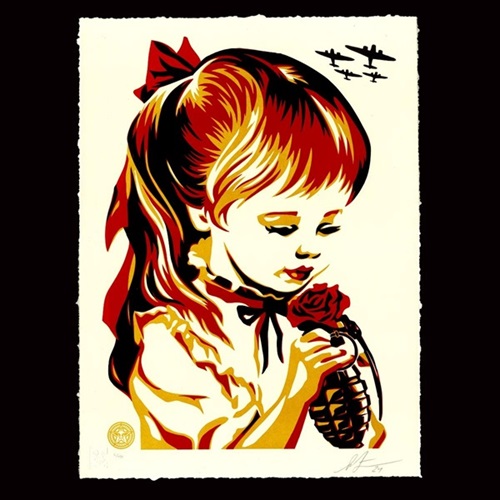
What is Shepard Fairey’s piece called “AR-15 Lily (Offset Lithograph)”?
Artist Statement
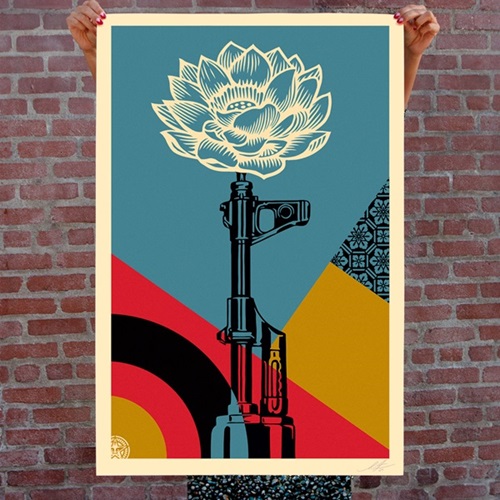
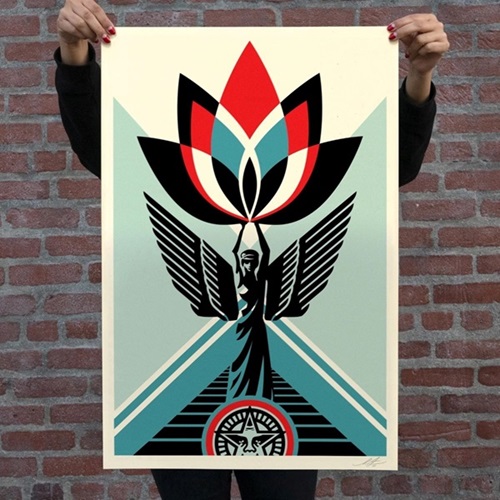
The AK-47 Lotus and AR-15 Lily images are inspired by Vietnam War protesters who would put flowers in the gun barrels of the National Guard who were brought in to suppress their protests for peace. I'm a pacifist, whether that means finding diplomatic solutions to prevent and avoid war internationally or finding diplomatic solutions to prevent and avoid gun violence at home. I want fewer people to die unnecessarily. Doctors Without Borders will receive a portion of proceeds from these two prints to support their efforts in war-torn parts of the world. Thanks for caring.? -Shepard? AK-47 Lotus & AR-15 Lily. 24 x 36 inches. Offset Lithograph on thick cream Speckletone paper. Signed by Shepard Fairey. Open edition (unnumbered). $40 each.
Summary
AR-15 Lily is a 2024 Shepard Fairey offset lithograph pairing a lily with an AR-15 rifle, part of a two-image set with AK-47 Lotus. The imagery references Vietnam War protesters who placed flowers in the gun barrels of the National Guard. Measuring 24 x 36 inches on thick cream Speckletone paper, this offset edition is signed and issued as an open, unnumbered edition by Obey Giant at $40. Fairey describes himself as a pacifist seeking diplomatic solutions to both international war and domestic gun violence. Doctors Without Borders receives a portion of proceeds from the print.
Why It Matters
AR-15 Lily updates one of the most enduring images in protest history, the flower placed in a gun barrel, for the era of domestic mass shootings. By substituting an AR-15, a rifle closely associated with American gun violence, for the Vietnam-era weapons of the original gesture, Fairey extends his anti-war pacifism into a contemporary domestic context, explicitly connecting international conflict and gun violence at home as twin causes of unnecessary death. Issued as a companion to AK-47 Lotus, the pairing creates a deliberate dialogue between two iconic firearms softened by floral symbols of peace, reinforcing the consistency of his pacifist stance across contexts. The work's availability as an accessible $40 open-edition offset lithograph reflects Fairey's recurring strategy of making message-driven imagery widely reachable, prioritizing dissemination over scarcity. The Doctors Without Borders partnership ties the release to humanitarian aid in war-torn regions, grounding the pacifist theme in concrete support. For collectors, AR-15 Lily is significant as a clear, image-forward anti-war statement that links the visual legacy of 1960s protest to present-day debates, and its open-edition format makes it an approachable entry into Fairey's peace-themed work.
Collector Perspective
AR-15 Lily appeals to collectors focused on Fairey's anti-war and peace messaging and to those who value works rooted in protest history, here the flower-in-the-gun-barrel image. As an open, unnumbered offset lithograph at a $40 release price, it is one of the most accessible formats in his catalog, well suited to newer collectors or anyone wanting a large 24 x 36 inch statement piece without a premium cost. It pairs directly with its companion AK-47 Lotus for a two-print display, and fits broader peace and floral-symbolism groupings. The Doctors Without Borders proceeds add cause-driven appeal. Because it is an open edition, buyers should view it as accessible message art rather than a scarcity-driven acquisition.
Historical Context
AR-15 Lily, dated February 2024, belongs to Fairey's sustained anti-war output and revives the Vietnam War-era protest image of flowers placed in soldiers' gun barrels. By updating that gesture with an AR-15, he links 1960s pacifism to contemporary American debates over gun violence, situating the print within his long-running engagement with peace themes. Released alongside AK-47 Lotus as an open-edition offset lithograph on cream Speckletone paper, it reflects Fairey's practice of offering accessible, widely distributed formats for his most message-driven imagery. Its alignment with Doctors Without Borders continues his pattern of pairing releases with humanitarian organizations, placing the work within his Modern Activism Era.
FAQ
What inspired AR-15 Lily?
Fairey says the image is inspired by Vietnam War protesters who placed flowers in the gun barrels of the National Guard. He updates the gesture with an AR-15 to connect anti-war pacifism to contemporary concerns about gun violence at home.
Is AR-15 Lily a numbered edition?
No. This offset lithograph is an open, unnumbered edition signed by Shepard Fairey and published by Obey Giant at $40. It was released alongside the companion print AK-47 Lotus.
What are the dimensions and materials?
AR-15 Lily measures 24 x 36 inches and is an offset lithograph on thick cream Speckletone paper, signed by Shepard Fairey.
Does this print support a cause?
Yes. According to the source, Doctors Without Borders receives a portion of proceeds from this print and its companion to support their efforts in war-torn parts of the world.
Related Works
About the Artist

Shepard Fairey (b. 1970, Charleston, South Carolina) is an American street artist, graphic designer, and activist, and a graduate of the Rhode Island School of Design. His 1989 “André the Giant Has a Posse” sticker grew into the global OBEY GIANT campaign — an ongoing experiment in propaganda, obedience, and visual culture. He reached worldwide recognition with the 2008 “Hope” portrait of Barack Obama, now held by the Smithsonian National Portrait Gallery. Across screen prints, stencils, murals, and collage, Fairey channels propaganda aesthetics toward themes of peace, justice, environmentalism, and civil rights. His work is in the collections of the Museum of Modern Art, the Victoria & Albert Museum, and LACMA.