Gauntlet Gallery
What is Shepard Fairey’s piece called “Catwoman Swindle”?
Artist Statement
CATWOMAN SWINDLE Screen Print 18 x 24 inches Edition of 300
Summary
Catwoman Swindle is a 2002 screen print by Shepard Fairey, published by Obey Giant in a first-edition run of 300, measuring 18 x 24 inches. The work centers on a female figure rendered in Fairey's high-contrast graphic style, drawing on comic-book and pop-culture iconography. The title's 'Swindle' framing connects it to Fairey's recurring play on appropriated imagery and media spectacle. The composition uses bold flat fields and stylized linework typical of his early-2000s output, presenting a woman as a strong central subject. Source fields tie it to themes of civil rights and justice alongside pop-culture collaboration.
Why It Matters
Catwoman Swindle sits at the intersection of two threads that define Fairey's early-2000s work: his fascination with pop-culture iconography and his ongoing visual study of strong female figures. The 'Swindle' label, recurring across his Sid Swindle and related prints from this period, signals Fairey's habit of appropriating and re-coding familiar imagery to comment on media and spectacle. With a modest first edition of 300, the print is a discrete artifact of how Fairey adapted recognizable characters into his propaganda-styled graphic language. The source assigns it both a civil-rights/justice reading and a pop-culture collaboration reading, making it a bridge between his overtly political portraiture and his playful, character-driven screen prints. For collectors tracking the evolution of Fairey's female subjects toward later works like Revolution Woman and Peace Woman, Catwoman Swindle is an early data point. Its compact edition size and 2002 date place it among the screen prints from a productive period before Fairey's national breakout, giving it documentary value within his catalog without overstating its rarity.
Collector Perspective
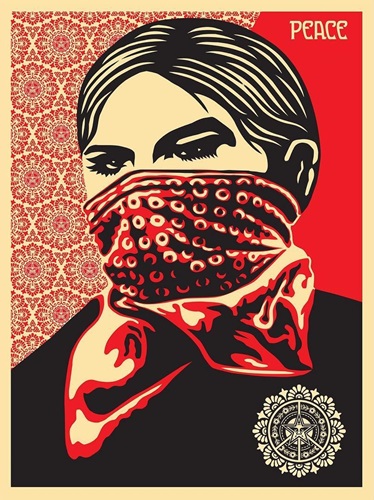
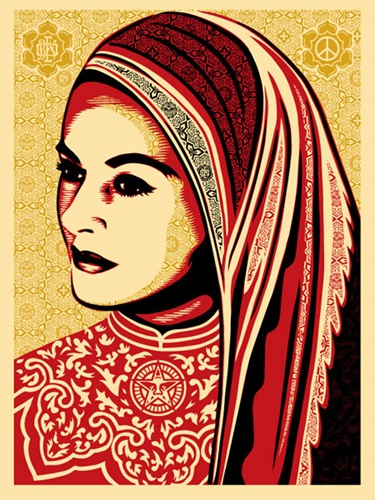
This print appeals to collectors who focus on Fairey's early-2000s screen prints and his recurring female-figure motif, as well as fans drawn to the pop-culture and comic crossover angle. At 18 x 24 inches it is an approachable size for framing in a gallery wall grouped with other 2002 Obey Giant editions. Collectors building a thematic set of Fairey's strong-woman imagery — moving from Catwoman Swindle toward Zapatista Woman, Revolution Woman, and Peace Woman — will value it as an early example. The edition of 300 makes it a moderately limited piece suitable for collectors who want a defined-edition screen print rather than an open offset. Its dual civil-rights and pop-culture framing gives it flexible placement in either a political or a culture-focused collection.
Historical Context
Catwoman Swindle dates to 2002, a prolific screen-printing year for Fairey in which he produced numerous portrait and character-based editions through Obey Giant. This period predates his 2008 Obama-era breakthrough and falls within his posters-and-propaganda phase, when he was refining the appropriation strategies and high-contrast graphic vocabulary that would later define his political portraiture. The 'Swindle' naming connects it to other 2002 works using the same conceptual frame, reflecting Fairey's interest in media spectacle and re-coded imagery. Within his arc, it documents how he applied his propaganda-poster aesthetic to pop-culture and comic subjects while continuing to develop the female-figure imagery that recurs throughout his later catalog.
FAQ
What is Catwoman Swindle and when was it made?
Catwoman Swindle is a screen print by Shepard Fairey from 2002, published by Obey Giant. It depicts a female figure in Fairey's high-contrast graphic style and connects to his pop-culture and civil-rights/justice themes. It was produced during one of his most active early-2000s screen-printing periods.
How large is the print and what is the edition size?
The print measures 18 x 24 inches and was released as a first edition of 300, all produced as screen prints by Obey Giant. This makes it a moderately limited edition from Fairey's early-2000s output.
What does the 'Swindle' in the title refer to?
The 'Swindle' framing recurs across several of Fairey's 2002 prints, including Sid Swindle, and reflects his interest in appropriating and re-coding familiar imagery to comment on media spectacle. The source does not assign a specific narrative beyond this pop-culture context.
How does this print fit Fairey's body of work?
It belongs to his posters-and-propaganda period before his 2008 national breakout, and it is an early example of the strong female-figure imagery that recurs in later works such as Revolution Woman and Peace Woman, blending pop-culture iconography with a justice-oriented reading.
Related Works


About the Artist

Shepard Fairey (b. 1970, Charleston, South Carolina) is an American street artist, graphic designer, and activist, and a graduate of the Rhode Island School of Design. His 1989 “André the Giant Has a Posse” sticker grew into the global OBEY GIANT campaign — an ongoing experiment in propaganda, obedience, and visual culture. He reached worldwide recognition with the 2008 “Hope” portrait of Barack Obama, now held by the Smithsonian National Portrait Gallery. Across screen prints, stencils, murals, and collage, Fairey channels propaganda aesthetics toward themes of peace, justice, environmentalism, and civil rights. His work is in the collections of the Museum of Modern Art, the Victoria & Albert Museum, and LACMA.