Gauntlet Gallery
What is Shepard Fairey’s piece called “The Beloved Premiere, We Are Blinded By Your Majesty”?
Artist Statement
THE BELOVED PREMIERE, WE ARE BLINDED BY YOUR MAJESTY Screen Print 26 x 32 inches Edition of 60 This print is also known as "LACMA" and "Mao Money Red" and was created for The Los Angeles Contemporary Museum of Modern Art. Signed edition of 60, 26 x 32 inch screen, three-color screenprint on 250 gsm Coventry Rag paper. Printed at Modern Multiples by Richard Duardo and Robert Acosta.
Summary
The Beloved Premiere, We Are Blinded By Your Majesty is a 2003 signed screen print published in connection with MOCA Los Angeles in an edition of 60. It is a three-color screenprint measuring 26 x 32 inches on 250 gsm Coventry Rag paper, printed at Modern Multiples by Richard Duardo and Robert Acosta. Also known as "LACMA" and "Mao Money Red," the work pairs Fairey's recurring Mao-derived imagery with themes of consumerism and power. The small signed edition, fine paper stock, and named master printers mark it as a more deliberate studio production than his standard poster runs. Source facts confirm the year, edition, dimensions, paper, and printers.
Why It Matters
This print stands out within Fairey's 2003 output because of its documented production pedigree and small signed edition. Created in connection with MOCA Los Angeles and printed at Modern Multiples by Richard Duardo - a legendary Los Angeles master printer - and Robert Acosta, it represents a more elevated, collaborative studio effort than Fairey's typical self-published posters. The three-color screenprint on 250 gsm Coventry Rag paper signals fine-art print intent, and the signed edition of just 60 places it among his scarcer titles of the period. The alternate names "LACMA" and "Mao Money Red" point to its engagement with Mao-derived iconography and the consumerism-and-power themes Fairey returns to repeatedly, using a recognizable political portrait to question authority and commerce. For collectors, the convergence of an institutional connection, a celebrated printer, archival paper, and a tiny edition makes it a standout. It bridges Fairey's street-rooted propaganda language and the museum-adjacent fine-print world, documenting a moment when his work was crossing into established art institutions. Because the source confirms the production details directly, the importance here rests on verifiable facts rather than interpretation, which strengthens its standing as a serious collector piece.
Collector Perspective
This title appeals to collectors who prioritize production quality, small editions, and institutional provenance. The named master printers - Richard Duardo and Robert Acosta at Modern Multiples - and the 250 gsm Coventry Rag paper give it appeal to those who value fine screenprinting craft. The signed edition of 60 makes it attractive to completists and to buyers chasing scarcer Fairey works. At 26 x 32 inches it is a substantial, gallery-scale piece with strong wall presence, anchored by bold Mao-derived imagery and a red palette. Within a collection it fits both a political/propaganda grouping and a museum-collaboration narrative, making it a versatile and prestigious centerpiece.
Historical Context
Produced in 2003 in connection with MOCA Los Angeles, this print marks a point when Fairey's work was moving toward institutional recognition. Printed at Modern Multiples by Richard Duardo and Robert Acosta, it ties Fairey to the Los Angeles screenprinting tradition Duardo helped define. Its Mao-derived imagery extends a motif Fairey had used since the late 1990s, repurposing an authoritarian icon to interrogate consumerism and power. The alternate names "LACMA" and "Mao Money Red" reflect how the piece circulated and how its red palette and currency-adjacent reading registered with audiences. Issued as a signed edition of 60 on archival paper, it sits within his propaganda-era practice while pointing forward to the larger gallery presence he would assume later in the decade.
FAQ
Why is this print also called LACMA and Mao Money Red?
The source notes the work is also known as "LACMA" and "Mao Money Red." These alternate names reflect how the piece circulated and how its red palette and Mao-derived currency-adjacent imagery were read. It was created in connection with The Los Angeles Contemporary Museum of Modern Art.
Who printed this edition?
It was printed at Modern Multiples by Richard Duardo and Robert Acosta. Duardo was a renowned Los Angeles master printer, and the involvement of named master printers marks this as a more deliberate fine-art studio production than Fairey's standard self-published posters.
What is the edition size and paper?
It is a signed edition of 60, produced as a three-color screenprint measuring 26 x 32 inches on 250 gsm Coventry Rag paper. The small signed run and archival paper place it among Fairey's scarcer and more carefully produced prints of the period.
What themes does it explore?
It pairs Fairey's recurring Mao-derived imagery with themes of consumerism and power, using a recognizable political portrait to question authority and commerce. The source confirms its institutional connection to MOCA Los Angeles and its production details.
Related Works
About the Artist
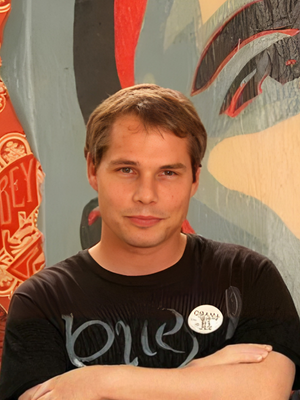
Shepard Fairey (b. 1970, Charleston, South Carolina) is an American street artist, graphic designer, and activist, and a graduate of the Rhode Island School of Design. His 1989 “André the Giant Has a Posse” sticker grew into the global OBEY GIANT campaign — an ongoing experiment in propaganda, obedience, and visual culture. He reached worldwide recognition with the 2008 “Hope” portrait of Barack Obama, now held by the Smithsonian National Portrait Gallery. Across screen prints, stencils, murals, and collage, Fairey channels propaganda aesthetics toward themes of peace, justice, environmentalism, and civil rights. His work is in the collections of the Museum of Modern Art, the Victoria & Albert Museum, and LACMA.