Gauntlet Gallery
What is Shepard Fairey’s piece called “Crowd 1”?
Artist Statement
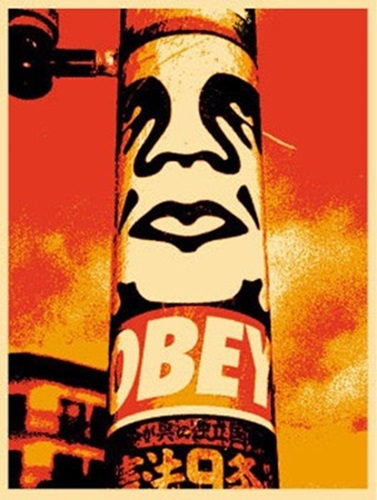
CROWD 1 / CROWD 2 Screen Print 18 x 24 inches Edition of 100 For the propaganda series, I wanted to create symmetrical images that could be spread across two posters horizontally. Since I could only print 18 x 24" images by hand, I wanted to make larger images—diptychs—that could cover more space. It also saved money, because I could make just one piece of film for the image, print it, then flip the film for the mirror image but cut out the type so it wouldn't read backwards. Essentially, I got two posters for the price of one.
Summary
Crowd 1 is a 1997 screen print published by Obey Giant in a first edition of 100, measuring 18 x 24 inches. It is the left-hand half of the Crowd 1 / Crowd 2 diptych. Fairey describes designing symmetrical images that could be spread horizontally across two posters; limited to printing 18 x 24 inch images by hand, he made a single piece of film, printed it, then flipped the film for the mirror image, cutting out the type so it would read correctly. The result is a propaganda-styled, money-and-power image of a crowd built to tile into a larger field.
Why It Matters
Crowd 1 is the anchor half of one of Fairey's documented early diptychs, and its value lies as much in the preserved making-of as in the image. The source carries his own account of engineering Crowd 1 / Crowd 2 to beat the size limit of hand-pulled screen printing: one piece of film, printed and flipped to mirror, producing two posters cheaply and a wider combined field for street use. That makes Crowd 1 a clear artifact of how production constraints shaped his early propaganda-series concepts. Thematically the source ties it to consumerism and power with propaganda and money signals, placing it among his critiques of crowds, commerce, and control. Its 1997 date and first edition of 100 set it in his formative Obey Giant period. Significance rests on this documented technique and theme, since the source supplies no pricing or market data, and interpretation here stays within those facts.
Collector Perspective
Crowd 1 appeals to collectors who prize concept and process, given the artist's preserved explanation of the diptych. It is strongest shown with Crowd 2, completing the mirrored composition and the consumerism-and-power statement. As a 1997 edition of 100 with documented commentary, it serves as a foundational, context-rich piece for a Fairey collection. The 18 x 24 inch format frames conventionally, and the pair extends into a wider field for a feature wall. It sits comfortably within a grouping of his late-1990s propaganda-series prints and pairs with his other Obey Giant works from the period.
Historical Context
Crowd 1 belongs to Fairey's 1997 propaganda series from the formative Obey Giant period of hand-pulled editioned prints. His preserved description shows him circumventing the technical ceiling of 18 x 24 inch hand printing by constructing horizontal diptychs from mirrored film, a practice rooted in his street-poster origins where covering wall space efficiently was a priority. Thematically it extends his interrogation of crowds, consumerism, and power. Within his arc, Crowd 1 documents the resourcefulness of his early methods and stands among the works that established his propaganda-inspired graphic language before his later national prominence.
FAQ
Is Crowd 1 part of a diptych?
Yes. The source identifies Crowd 1 / Crowd 2 as a paired diptych, with symmetrical images Fairey designed to spread horizontally across two posters and cover more wall space when displayed together.
How was Crowd 1 printed?
Per Fairey's description in the record, he made one piece of film, printed it, then flipped the film for the mirror image, cutting out the type so it would not read backwards. This produced two posters from a single film economically.
What are the edition, medium, and size?
Crowd 1 is a screen print measuring 18 x 24 inches in a first edition of 100, published by Obey Giant in 1997, according to the source data.
What is its theme?
The record tags it with consumerism and power, with theme signals of propaganda and money. It belongs to Fairey's propaganda series examining crowds, commerce, and control.
Related Works

About the Artist

Shepard Fairey (b. 1970, Charleston, South Carolina) is an American street artist, graphic designer, and activist, and a graduate of the Rhode Island School of Design. His 1989 “André the Giant Has a Posse” sticker grew into the global OBEY GIANT campaign — an ongoing experiment in propaganda, obedience, and visual culture. He reached worldwide recognition with the 2008 “Hope” portrait of Barack Obama, now held by the Smithsonian National Portrait Gallery. Across screen prints, stencils, murals, and collage, Fairey channels propaganda aesthetics toward themes of peace, justice, environmentalism, and civil rights. His work is in the collections of the Museum of Modern Art, the Victoria & Albert Museum, and LACMA.