Gauntlet Gallery
What is Shepard Fairey’s piece called “Website”?
Artist Statement
WEBSITE Screen Print 18 x 24 inches Edition of 100 I made this poster not long after I created my website. I had always felt like sitting in front of a computer was a waste of time and the Internet was for geeks, and I had never been a big TV watcher either, so I had this concept of people being hypnotized by a screen. At the same time, I came to realize that the Internet is a great tool for information, and it really helped me to be more independent and self-sufficient, allowing me to handle my own sales and not have to hound stores for money. This poster kind of makes fun of the idea that Big Brother is behind the screen, hypnotizing you, yet he's also promoting my website in the process.
Summary
Website is a 1999 Shepard Fairey screen print, published by Obey Giant as a first edition of 100, measuring 18 x 24 inches. Made shortly after Fairey launched his own website, the image plays on the idea of people hypnotized by a screen, with a Big Brother figure positioned behind it. By Fairey's account the poster both critiques the notion of an authority hypnotizing viewers through the screen and, ironically, promotes his website in the same gesture. It is a hand-pulled screen print combining media critique with self-aware Obey iconography.
Why It Matters
Website is one of the more conceptually self-aware prints of Fairey's early period, and it is unusually well documented in his own words. Created just after he built his website, it stages a tension Fairey names directly: he had dismissed computers and the internet as a waste of time, then came to value the web as a tool for information and independence that let him handle his own sales rather than chasing stores for payment. The image dramatizes that ambivalence by casting a Big Brother figure as the hypnotic presence behind the screen, while the same poster promotes his site. That double move, critiquing screen-based control and participating in it, captures a central paradox of the Obey project, which both mocks propaganda and deploys its techniques. The secondary theme of consumerism and power reinforces this reading. For collectors, the work matters because it is an early, edition-of-100 screen print with a rare first-person artist statement that ties it to a specific moment in Fairey's transition toward self-directed distribution. It anticipates surveillance and media-saturation themes that recur across his later work, making it a documentary as well as a visual object.
Collector Perspective
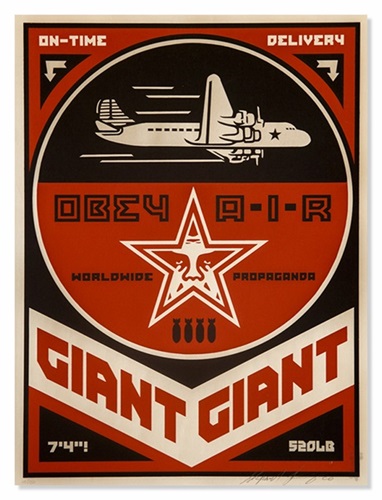
Website appeals to collectors who prize prints with strong conceptual narratives and direct artist commentary, since Fairey's own statement explains its meaning and origin. Its surveillance-and-media subject gives it thematic depth that rewards display and discussion, fitting collections oriented toward Fairey's critique of power and media rather than purely decorative walls. At 18 x 24 inches with an edition of 100, it is a scarce early piece that frames well and pairs naturally with other late-1990s and turn-of-the-decade Obey works engaging consumerism and propaganda, such as the Crowd prints and Obey Air. Collectors building a thematic surveillance or media-critique grouping will find it a documented anchor.
Historical Context
Website dates to 1999, late in the foundational run of Obey Giant editions, and coincides with Fairey's adoption of the internet for self-distribution. By his account it followed soon after he created his website, marking a practical shift toward handling his own sales rather than relying on stores. Thematically it sits within his ongoing engagement with propaganda, surveillance, and the Big Brother motif, here turned toward screen culture rather than the street paste-ups that defined his earliest work. The print belongs to the same small-edition cohort as his other late-1990s screen prints and predates his broad mainstream recognition, while pointing forward to the media- and power-critique themes that recur throughout his later career.
FAQ
What is Website about?
Fairey made it after launching his own website. The image plays on people being hypnotized by a screen, with a Big Brother figure behind it. He described it as mocking the idea that Big Brother hypnotizes you through the screen, while the same poster promotes his website.
When was it made and what are its specifications?
Website was created in 1999, published by Obey Giant. It is a hand-pulled screen print measuring 18 x 24 inches, issued as a first edition of 100.
Why is the artist's own statement significant?
Fairey explained that he had dismissed the internet as a waste of time before realizing it helped him become self-sufficient and handle his own sales. The print captures that ambivalence, both critiquing screen-based control and participating in it.
What themes does it engage?
The record lists collaborations/pop culture and consumerism and power as its themes. The Big Brother-behind-the-screen concept ties it to Fairey's recurring interests in surveillance, media, and propaganda.
Related Works

About the Artist

Shepard Fairey (b. 1970, Charleston, South Carolina) is an American street artist, graphic designer, and activist, and a graduate of the Rhode Island School of Design. His 1989 “André the Giant Has a Posse” sticker grew into the global OBEY GIANT campaign — an ongoing experiment in propaganda, obedience, and visual culture. He reached worldwide recognition with the 2008 “Hope” portrait of Barack Obama, now held by the Smithsonian National Portrait Gallery. Across screen prints, stencils, murals, and collage, Fairey channels propaganda aesthetics toward themes of peace, justice, environmentalism, and civil rights. His work is in the collections of the Museum of Modern Art, the Victoria & Albert Museum, and LACMA.