Gauntlet Gallery
What is Shepard Fairey’s piece called “American Civics - Two Americas”?
Artist Statement
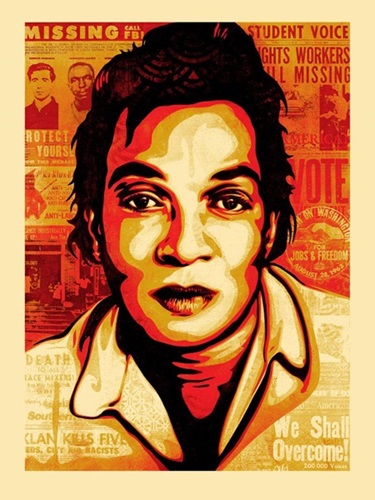
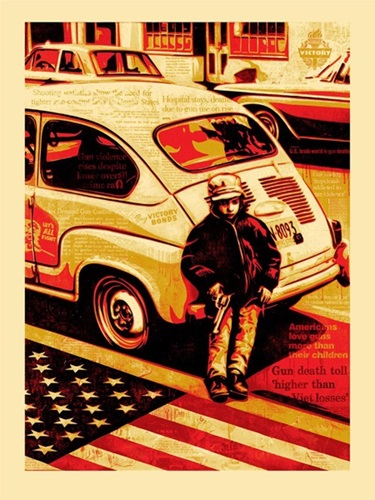
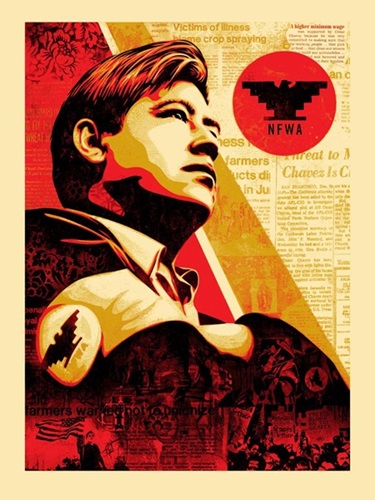
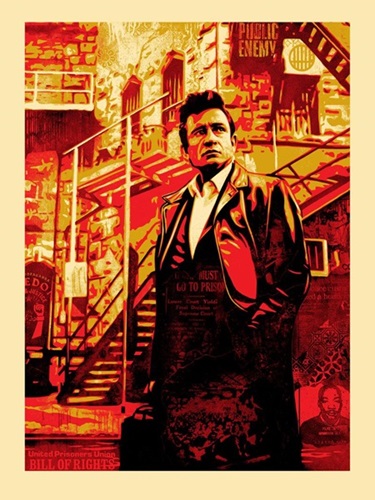
The first-ever collaboration between Shepard and the estate of legendary photographer Jim Marshall, American Civics, debuts this month! Shepard is interpreting Marshall's iconic photography from the 1960's, including images of Johnny Cash, Cesar Chavez, and Fannie Lee Chaney, with five new works, vividly depicting the humanity behind some of the country's enduring social issues: Voting Rights, Mass Incarceration, Worker's Rights, Gun Culture, and Two Americas. "In this piece, I completely changed the composition. I have the mother behind the kids as if she's leaning over them in a protective way. In the original photograph, she's off to the side. Also, a lot of the things I've woven into the collage and the background are really important. I've tried to render the window so it's light outside, [because] it's very dark outside and doesn't come across in the original photo."
Summary
American Civics - Two Americas is a 2016 screen print measuring 30 x 40 inches, published by San Francisco Art Exchange in an edition of 100 at $1,800. It is part of American Civics, the first collaboration between Shepard Fairey and the estate of photographer Jim Marshall, interpreting Marshall's 1960s photography. The series of five works addresses Voting Rights, Mass Incarceration, Worker's Rights, Gun Culture, and Two Americas. For this piece, Fairey recomposed Marshall's image, placing a mother protectively behind her children, woven with background and collage elements and a lightened window, departing from the darker original photograph.
Why It Matters
Two Americas anchors Fairey's American Civics suite, his first-ever collaboration with the estate of legendary photographer Jim Marshall, whose 1960s images of figures like Johnny Cash, Cesar Chavez, and Fannie Lee Chaney document a pivotal era of American social struggle. By reinterpreting Marshall's photographs across five themes, Voting Rights, Mass Incarceration, Worker's Rights, Gun Culture, and Two Americas, Fairey links his graphic activism to one of the foremost photographic chroniclers of the civil-rights and counterculture decades. This piece is notable for Fairey's hands-on recomposition: he explains how he moved the mother behind her children in a protective posture and brightened the window to reveal the world outside, deliberately reshaping Marshall's documentary frame into a charged narrative image about inequality and the divide between two Americas. At a 30 x 40 inch scale in an edition of just 100 priced at $1,800, it sits among the more ambitious and premium offerings of his 2016 output. Its fusion of civil-rights subject matter, archival photographic source, and estate collaboration gives it significance well beyond a standard print.
Collector Perspective
This appeals to collectors of socially engaged art and to those who value the crossover with Jim Marshall's celebrated documentary photography. As a keystone of the American Civics series, it draws buyers assembling the full five-work suite as well as those seeking a single statement piece on inequality and civil rights. The large 30 x 40 inch format and edition of only 100 give it presence and relative scarcity, while the Marshall estate collaboration adds a layer of provenance prized by photography and fine-art collectors alike. At an $1,800 issue price it targets serious collectors rather than entry-level buyers. It fits a collection focused on civil rights, social justice, or Fairey's photographer collaborations, and rewards those drawn to its documented compositional reworking of a historic image.
Historical Context
Released in May 2016 through San Francisco Art Exchange, American Civics marked the first-ever collaboration between Shepard Fairey and the estate of Jim Marshall, the photographer renowned for documenting music and social movements of the 1960s. The series translates Marshall's images of figures including Johnny Cash, Cesar Chavez, and Fannie Lee Chaney into five works confronting enduring American social issues. Two Americas exemplifies Fairey's mature method of building on archival photography while substantially recomposing it, here repositioning a mother and children and altering the lighting to sharpen the narrative. The project situates Fairey within a lineage of civil-rights and protest imagery and reflects his mid-2010s emphasis on partnering with major photographic estates to ground his activism in historic documentary material.
FAQ
What is the American Civics series?
American Civics is the first-ever collaboration between Shepard Fairey and the estate of photographer Jim Marshall. Fairey interprets Marshall's iconic 1960s photography, including images of Johnny Cash, Cesar Chavez, and Fannie Lee Chaney, across five works addressing Voting Rights, Mass Incarceration, Worker's Rights, Gun Culture, and Two Americas.
How did Fairey change the original photograph?
Fairey says he completely changed the composition, placing the mother behind the children as if leaning over them protectively, whereas in Marshall's original she is off to the side. He also rendered the window so it appears light outside, since the original photo was very dark and did not convey that, and wove in collage and background details.
What is the edition size and price?
Two Americas is a screen print in an edition of 100, with an original issue price of $1,800. It measures 30 by 40 inches and was published by San Francisco Art Exchange in 2016 as part of the American Civics series.
Why is the Jim Marshall collaboration notable?
The source describes it as the first-ever collaboration between Shepard and the estate of the legendary photographer Jim Marshall. Marshall documented major figures and social issues of the 1960s, and Fairey reinterprets that photography to highlight the humanity behind enduring American social issues.
Related Works
About the Artist

Shepard Fairey (b. 1970, Charleston, South Carolina) is an American street artist, graphic designer, and activist, and a graduate of the Rhode Island School of Design. His 1989 “André the Giant Has a Posse” sticker grew into the global OBEY GIANT campaign — an ongoing experiment in propaganda, obedience, and visual culture. He reached worldwide recognition with the 2008 “Hope” portrait of Barack Obama, now held by the Smithsonian National Portrait Gallery. Across screen prints, stencils, murals, and collage, Fairey channels propaganda aesthetics toward themes of peace, justice, environmentalism, and civil rights. His work is in the collections of the Museum of Modern Art, the Victoria & Albert Museum, and LACMA.