Gauntlet Gallery
What is Shepard Fairey’s piece called “American Civics - Gun Culture”?
Artist Statement
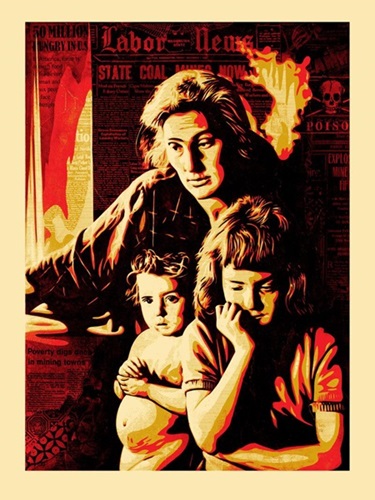
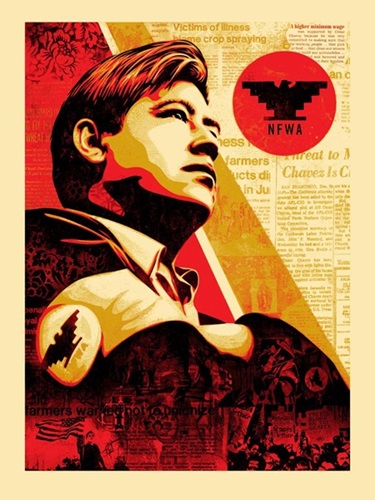
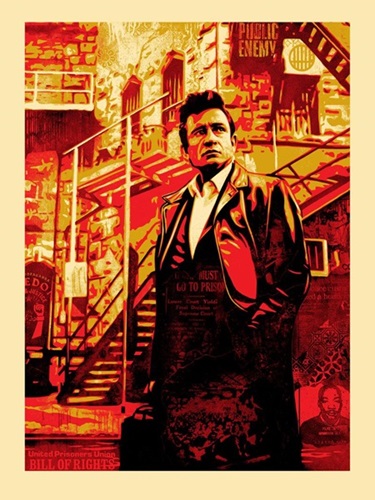
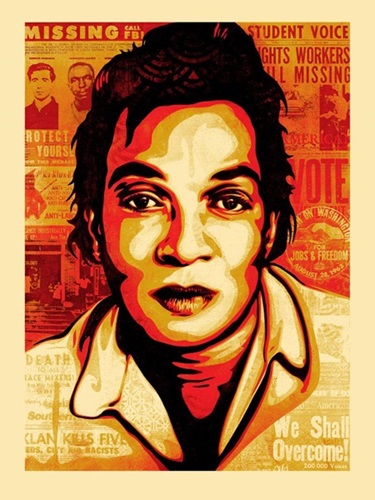
The first-ever collaboration between Shepard and the estate of legendary photographer Jim Marshall, American Civics, debuts this month! Shepard is interpreting Marshall's iconic photography from the 1960's, including images of Johnny Cash, Cesar Chavez, and Fannie Lee Chaney, with five new works, vividly depicting the humanity behind some of the country's enduring social issues: Voting Rights, Mass Incarceration, Worker's Rights, Gun Culture, and Two Americas. "This obsession with guns is ingrained, and it starts at a young age. And that kid could have innocently been playing 'good guys and bad guys,' but it also has a deeper implication of just how culturally ingrained guns are and how that allows gun ownership to trump safety. The sidewalk is the American flag. That to me — it's such a loaded symbol — and sometimes that can be something that is an easy gimmick, but I really think it's meaningful in this because it's almost [as if] you're un-American if you don't support gun rights."
Summary
Gun Culture is a 2016 screen print from Shepard Fairey's American Civics series, his first collaboration with the estate of photographer Jim Marshall. The image confronts how deeply guns are culturally ingrained in America, using a sidewalk rendered as the American flag as a loaded symbol of how gun rights become equated with patriotism. Published by San Francisco Art Exchange in a first edition of 100, the print measures 40 x 30 inches. One of five works addressing enduring social issues, it reinterprets Marshall's 1960s photography through Fairey's graphic, propaganda-influenced style to question how gun ownership is taught from a young age.
Why It Matters
Gun Culture sits within American Civics, Fairey's first collaboration with the Jim Marshall photography estate and a deliberate effort to depict the humanity behind divisive American social issues. The work is notable for its layered symbolism: a child at play whose innocence carries a deeper implication about how gun ownership is normalized from youth, and a sidewalk transformed into the American flag to suggest that gun rights have become a test of patriotism. Fairey himself acknowledged the flag is a loaded symbol that can read as gimmick but here, he argues, it is meaningful. For collectors, this makes the print one of the series' most pointedly editorial images, engaging the gun debate without caricature. Its first edition of 100, 40 x 30 inch scale, and SFAE pedigree mark it as a lower-run, fine-art-format work distinct from Fairey's mass-produced posters. As part of a cohesive five-work set, it contributes to a body of mid-2010s output where Fairey paired documentary source material with social-justice critique.
Collector Perspective
Gun Culture draws collectors interested in Fairey's most politically pointed work and in the American flag motif that recurs across his career. The provocative subject and flag-as-sidewalk device make it a conversation piece suited to collectors comfortable displaying overtly editorial art. At 40 x 30 inches it commands wall space and reads as a serious screen print rather than a poster. Buyers assembling the complete American Civics set will treat it as essential to the five-work group, and its small first edition of 100 with San Francisco Art Exchange publication appeals to those who prioritize scarcity and message. It fits naturally into politically themed Fairey collections alongside the other Civics works.
Historical Context
Gun Culture belongs to Fairey's mid-2010s turn toward documented American social issues filtered through collaboration. Debuting in May 2016, the American Civics series was his first project with the estate of photographer Jim Marshall, reinterpreting Marshall's 1960s imagery to address voting rights, mass incarceration, workers' rights, gun culture, and two Americas. Released in an election year, the series extended Fairey's long-standing engagement with civic and justice themes. Gun Culture in particular reflects his recurring use of the American flag as a contested symbol, a device he has deployed across his catalog to question patriotism and power. Published by San Francisco Art Exchange, it represents the artist's continued movement toward fine-art-format screen prints carrying explicit social commentary.
FAQ
What does Gun Culture depict?
It addresses how deeply guns are culturally ingrained in America. Fairey describes a child who could be innocently playing yet embodies how gun ownership is taught young, with a sidewalk rendered as the American flag to suggest gun rights have become a measure of patriotism.
What edition and size is this print?
Published by San Francisco Art Exchange, it is a first edition of 100. The screen print measures 40 inches high by 30 inches wide, placing it among Fairey's larger-format, lower-run works.
How does it relate to the American Civics series?
It is one of five works in American Civics, Fairey's first collaboration with the Jim Marshall estate, interpreting Marshall's 1960s photography to address voting rights, mass incarceration, workers' rights, gun culture, and two Americas.
Why is the American flag in the image?
Fairey turned the sidewalk into the American flag as a deliberately loaded symbol. He notes it can risk being a gimmick but here is meaningful, conveying the idea that one is almost seen as un-American for not supporting gun rights.
Related Works
About the Artist
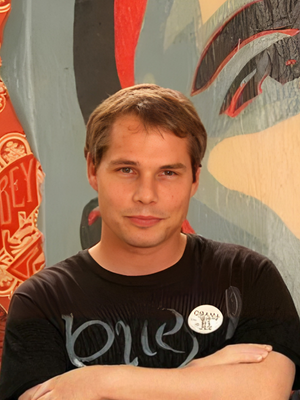
Shepard Fairey (b. 1970, Charleston, South Carolina) is an American street artist, graphic designer, and activist, and a graduate of the Rhode Island School of Design. His 1989 “André the Giant Has a Posse” sticker grew into the global OBEY GIANT campaign — an ongoing experiment in propaganda, obedience, and visual culture. He reached worldwide recognition with the 2008 “Hope” portrait of Barack Obama, now held by the Smithsonian National Portrait Gallery. Across screen prints, stencils, murals, and collage, Fairey channels propaganda aesthetics toward themes of peace, justice, environmentalism, and civil rights. His work is in the collections of the Museum of Modern Art, the Victoria & Albert Museum, and LACMA.