Gauntlet Gallery
What is Shepard Fairey’s piece called “Obey Air”?
Artist Statement
OBEY AIR Screen Print 18 x 24 inches Edition of 150
Summary
Obey Air is a 2000 screen print published by Obey Giant in a first edition of 150, measuring 18 x 24 inches. The source provides only minimal cataloguing detail beyond title, medium, dimensions, and edition, while flagging consumerism and power as a secondary theme. As an OBEY-branded design echoing corporate and athletic-brand naming, it appears to align with Fairey's parody of commercial logos and consumer culture, rendered in his flat, high-contrast graphic style. Without a fuller description, the specific composition is best read cautiously.
Why It Matters
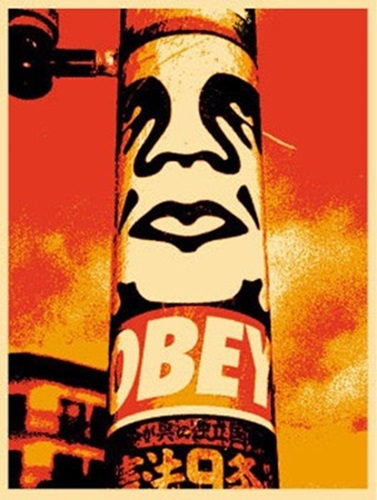
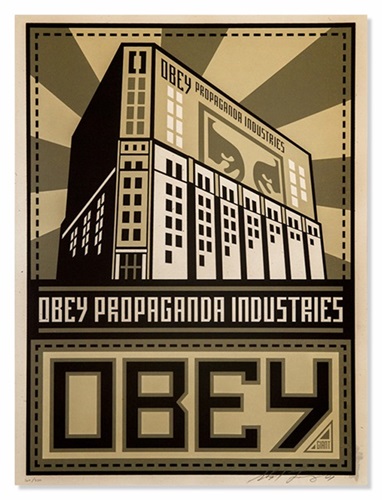
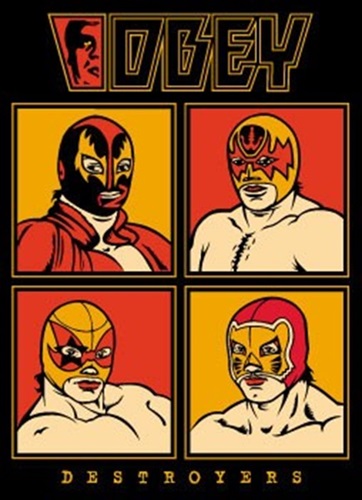
Obey Air sits within Fairey's long-running parody of corporate branding, in which he grafts the OBEY name onto the visual conventions of commercial logos to expose how advertising commands obedience from consumers. The title's echo of athletic-brand naming, combined with the source's secondary theme of consumerism and power, signals a work aimed squarely at the language of marketing and brand authority. With limited description, its importance is best framed cautiously as a representative example of his corporate-critique vocabulary rather than a documented landmark. For collectors, the appeal lies in the small first edition of 150 and its fit within a group of his OBEY-brand-parody works, such as Obey Pole, Propaganda Industries, and Obey Destroyers. The strategy of mimicking consumer branding to interrogate it is central to Fairey's OBEY project, which itself functions as a faux-brand commentary on power and persuasion. As a node in that corporate-critique output, Obey Air offers an on-brand acquisition, though firm claims about its specific imagery should await fuller documentation.
Collector Perspective
Obey Air appeals to collectors focused on Fairey's corporate-critique and brand-parody works, and to those interested in the OBEY project as a faux-brand commentary on consumer culture. With a small first edition of 150, it is a relatively accessible piece, well suited to building a thematic group around his logo-parody prints alongside Obey Pole, Propaganda Industries, and Obey Destroyers. At 18 x 24 inches it frames easily and reads well in a cluster of brand-language works. The source flags consumerism and power as a secondary theme, reinforcing that conceptual fit. Because the description is sparse, collectors should verify the specific imagery before relying on it. Its appeal is largely contextual: a representative, affordable example of Fairey's commercial-branding critique from the 2000 period.
Historical Context
Obey Air dates to 2000 and falls within the Posters and Propaganda phase, when Fairey's Obey Giant studio was issuing screen prints that often parodied corporate and commercial branding. The OBEY project itself operates as a faux-brand, mimicking the visual authority of advertising to question how consumers are conditioned to obey, and Obey Air extends that strategy through a title echoing commercial-brand naming. The source's secondary consumerism-and-power tag underscores this focus. Coming after his late-1980s and 1990s sticker campaigns, the print reflects the maturation of OBEY as a critical brand-language tool. With limited documentation, its precise role is best stated cautiously, but it is consistent with the corporate-critique works that recur across this era of his output.
FAQ
What is the edition size of Obey Air?
It is a first edition of 150, published by Obey Giant in 2000. The edition size, title, medium, and dimensions are all stated in the source record.
What are the dimensions and medium?
It is a screen print measuring 18 x 24 inches, consistent with Fairey's other Obey Giant prints from the same year. These details come directly from the source.
What theme does the print address?
The source tags consumerism and power as a secondary theme. The OBEY Air title echoes commercial-brand naming, aligning the work with Fairey's parody of corporate logos and advertising, though the specific imagery is not detailed in the record.
How does it relate to his other OBEY-brand works?
It fits among Fairey's faux-corporate-branding prints, including Obey Pole, Propaganda Industries, and Obey Destroyers, all of which mimic commercial logo language to critique consumer obedience and brand authority.
Related Works

About the Artist

Shepard Fairey (b. 1970, Charleston, South Carolina) is an American street artist, graphic designer, and activist, and a graduate of the Rhode Island School of Design. His 1989 “André the Giant Has a Posse” sticker grew into the global OBEY GIANT campaign — an ongoing experiment in propaganda, obedience, and visual culture. He reached worldwide recognition with the 2008 “Hope” portrait of Barack Obama, now held by the Smithsonian National Portrait Gallery. Across screen prints, stencils, murals, and collage, Fairey channels propaganda aesthetics toward themes of peace, justice, environmentalism, and civil rights. His work is in the collections of the Museum of Modern Art, the Victoria & Albert Museum, and LACMA.