Gauntlet Gallery
What is Shepard Fairey’s piece called “Chinese Building”?
Artist Statement
CHINESE BUILDING Screen Print 18 x 24 inches Edition of 300
Summary
Chinese Building is a 2001 Shepard Fairey screen print published by Obey Giant in a first edition of 300, measuring 18 x 24 inches. The title points to Chinese architectural or urban imagery, fitting Fairey's recurring use of Chinese visual motifs and propaganda-influenced subjects in this period. The record assigns it a pop-culture theme and confirms medium, year, dimensions, and edition size, but contains no extended artist statement, so the specific composition is not detailed here beyond the building subject. The edition of 300 places it among the larger runs of the period.
Why It Matters
Chinese Building belongs to Fairey's 2001 output and to a recurring strand of his work that draws on Chinese architecture, signage, and propaganda aesthetics, a vein that also runs through prints like Chinese Stencil, Chinese Soldier, and Chinese San Francisco. For collectors, it matters as a representative example of how Fairey absorbed Asian urban and communist visual culture into his graphic vocabulary, often using such imagery to comment on power, ideology, and the global circulation of propaganda forms. The edition of 300 is among the larger period runs, making it more accessible and liquid than his scarcest sheets, which can be a plus for collectors entering this part of his catalog. Its database value lies in connecting it to the broader Chinese-themed cluster across multiple years, showing it as one node in a sustained interest rather than an isolated piece. Because the source supplies only the title, theme, and production facts, the interpretation here is deliberately cautious, grounded in Fairey's documented use of Chinese imagery rather than asserting compositional specifics the record does not contain. That restraint keeps the entry honest for a collector comparing it against better-documented Chinese-themed works.
Collector Perspective
Chinese Building suits collectors interested in Fairey's Chinese-themed and propaganda-influenced imagery and those who want an accessible entry point into his 2001 catalog. The larger edition of 300 generally means easier availability and a more approachable position than his scarce sheets, which appeals to newer collectors. At 18 x 24 inches it frames easily and pairs well in a grouping with his other China-referencing prints. It is a good fit for buyers assembling a thematic set around Fairey's engagement with Asian urban and communist visual culture rather than those chasing maximum rarity. Limited documentation means independent provenance and condition checks are advisable.
Historical Context
Chinese Building dates to 2001 and sits within Fairey's posters-and-propaganda phase, alongside a recurring series of China-referencing prints spanning the late 1990s through the mid-2000s, from Chinese Soldier to Chinese San Francisco. This thread reflects his sustained fascination with Chinese architecture, signage, and communist propaganda aesthetics, which he folded into his graphic vocabulary to comment on ideology and power. The edition of 300 marks it as one of the more widely produced works of the period. Anchored by its 2001 date and Obey Giant publisher, it represents a steady, motif-driven part of Fairey's catalog rather than a singular departure.
FAQ
When was Chinese Building created and who published it?
Chinese Building was created in 2001 and published by Obey Giant. It is a screen print and part of Fairey's recurring use of Chinese architectural and propaganda-influenced imagery across several years.
What is the edition size and dimensions?
It is a first edition of 300 copies, measuring 18 x 24 inches. The edition of 300 places it among the larger runs of Fairey's 2001 output.
How does it relate to Fairey's other work?
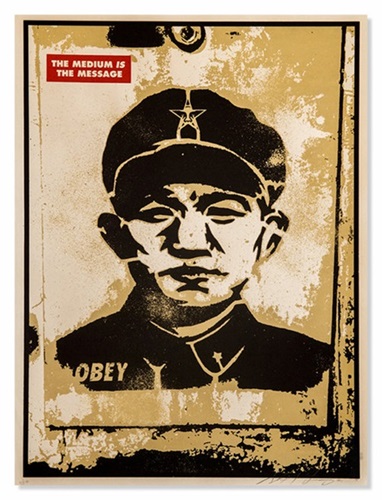
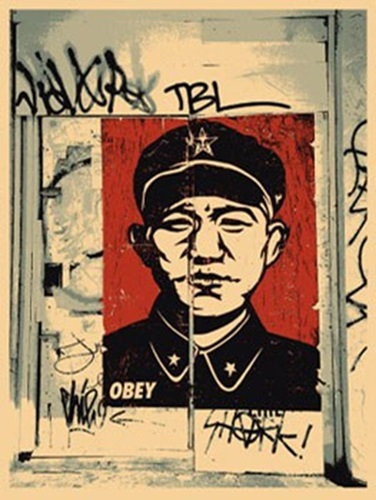
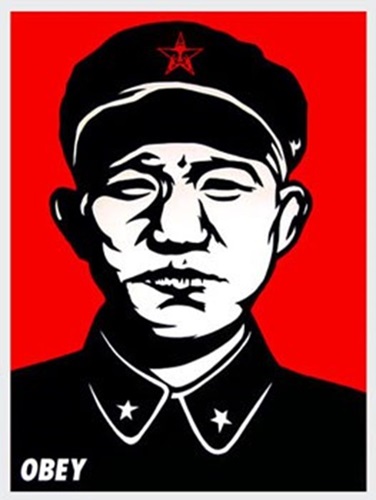
It belongs to a cluster of China-referencing prints, including Chinese Stencil, Chinese Soldier, and Chinese San Francisco, that draw on Asian urban and communist visual culture. The record does not include an artist statement, so details beyond the building subject are not documented.
Is this a rare print?
With an edition of 300, it is relatively common compared with Fairey's smaller editions, which can make it more accessible. The source does not state it is sold out, and no market or auction value is recorded in the data.
Related Works

About the Artist

Shepard Fairey (b. 1970, Charleston, South Carolina) is an American street artist, graphic designer, and activist, and a graduate of the Rhode Island School of Design. His 1989 “André the Giant Has a Posse” sticker grew into the global OBEY GIANT campaign — an ongoing experiment in propaganda, obedience, and visual culture. He reached worldwide recognition with the 2008 “Hope” portrait of Barack Obama, now held by the Smithsonian National Portrait Gallery. Across screen prints, stencils, murals, and collage, Fairey channels propaganda aesthetics toward themes of peace, justice, environmentalism, and civil rights. His work is in the collections of the Museum of Modern Art, the Victoria & Albert Museum, and LACMA.