Gauntlet Gallery
What is Shepard Fairey’s piece called “Third Eye Butterfly Mandala (Blue (Small))”?
Artist Statement
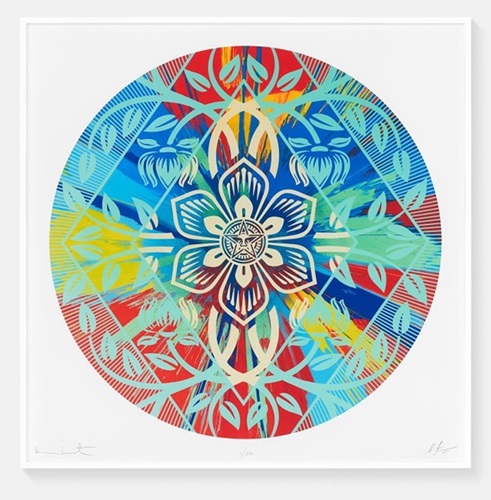
Shepard Fairey and Damien Hirst Third Eye Butterfly Mandala (Blue)(Small), 2026 Giclée print on smooth cotton rag 107.1 x 80.9 cm (framed) $2,500
Summary
Third Eye Butterfly Mandala (Blue) is a 2026 collaboration between Shepard Fairey and Damien Hirst, published by HENI Editions. The giclee print on smooth cotton rag combines Fairey's mandala and graphic language with Hirst's butterfly motif into a symmetrical kaleidoscopic composition. The Small format measures 107.1 x 80.9 cm framed, and the edition is offered in Blue and Cream colorways across Small and Large sizes, with a recorded edition figure of 267. Listed at $2,500, it sits among the higher-priced, fine-art editions in Fairey's catalog. The work foregrounds nature and floral symbolism through the butterfly-and-mandala form.
Why It Matters
This print is significant as a cross-artist collaboration pairing Shepard Fairey with Damien Hirst, two figures from very different corners of contemporary art, published through HENI Editions rather than Fairey's usual imprints. The butterfly, a signature Hirst motif, is fused with Fairey's mandala vocabulary, producing a hybrid image that carries the visual DNA of both artists. For collectors, that dual authorship elevates the work above a standard Fairey screen print: it represents a meeting of two market-recognized names and a giclee-on-cotton-rag fine-art production at a $2,500 price point, well above his accessible editions. The mandala-and-butterfly form ties into themes of nature and floral symbolism that recur across Fairey's decorative and meditative works. Offered across multiple colorways and sizes, the release functions as a small family of variants, giving collectors choice in scale and palette. Its higher price, framed presentation, and collaborative pedigree position it as a statement acquisition for buyers interested in the intersection of street-art-rooted graphic design and blue-chip contemporary art, rather than a mass-market poster purchase.
Collector Perspective
This collaboration appeals to collectors who value cross-artist editions and the prestige of both Fairey and Damien Hirst on a single work. At $2,500 with a giclee-on-cotton-rag production and framed presentation, it targets more committed buyers than Fairey's entry-level screen prints. The mandala-and-butterfly symmetry makes a bold decorative centerpiece, and the availability of Blue and Cream colorways across Small and Large sizes lets buyers match scale and palette to their space. It fits a collection oriented around collaborations, decorative mandala works, or contemporary fine-art editions. The HENI Editions publishing and dual authorship add provenance weight for collectors focused on names and market pedigree.
Historical Context
Third Eye Butterfly Mandala places Fairey in dialogue with Damien Hirst, marking a notable cross-pollination between Fairey's graphic, street-rooted practice and Hirst's blue-chip contemporary-art world. Published by HENI Editions, it reflects Fairey's contemporary-period willingness to work outside his own imprints on higher-end giclee productions. The mandala form has long appeared in Fairey's decorative and symbolic work, and here it merges with Hirst's recurring butterfly imagery. Within Fairey's arc, this 2026 release exemplifies his late-career expansion into prestige collaborations and fine-art editions, broadening his reach beyond activist posters and modular screen prints into the gallery-edition market where dual-artist provenance carries significant collector appeal.
FAQ
Who created Third Eye Butterfly Mandala?
It is a 2026 collaboration between Shepard Fairey and Damien Hirst, published by HENI Editions, combining Fairey's mandala vocabulary with Hirst's butterfly motif.
What are the medium and dimensions?
It is a giclee print on smooth cotton rag. The Small format measures 107.1 x 80.9 cm framed, and the release spans Blue and Cream colorways in Small and Large sizes.
What was the listed price?
The print was listed at $2,500, placing it among the higher-priced fine-art editions in Fairey's catalog.
What variants are available?
The edition is offered across four variants: Blue (Large), Blue (Small), Cream (Large), and Cream (Small), giving collectors a choice of palette and scale.
Related Works
About the Artist

Shepard Fairey (b. 1970, Charleston, South Carolina) is an American street artist, graphic designer, and activist, and a graduate of the Rhode Island School of Design. His 1989 “André the Giant Has a Posse” sticker grew into the global OBEY GIANT campaign — an ongoing experiment in propaganda, obedience, and visual culture. He reached worldwide recognition with the 2008 “Hope” portrait of Barack Obama, now held by the Smithsonian National Portrait Gallery. Across screen prints, stencils, murals, and collage, Fairey channels propaganda aesthetics toward themes of peace, justice, environmentalism, and civil rights. His work is in the collections of the Museum of Modern Art, the Victoria & Albert Museum, and LACMA.