Gauntlet Gallery
What is Shepard Fairey’s piece called “Marcos Collage”?
Artist Statement
MARCOS COLLAGE Screen Print 36 x 48 inches Edition of 63
Summary
Marcos Collage is a 2003 screen print published by Obey Giant in a first edition of 63, measuring 36 x 48 inches. The large-format work depicts Subcomandante Marcos, the masked spokesman of Mexico's Zapatista movement, rendered in Fairey's layered collage-and-propaganda style. Its scale and small edition mark it as one of his more ambitious political portraits of the period. The piece belongs to a group of revolutionary-figure collages Fairey produced in the early 2000s alongside Mao and Castro. Source facts confirm the year, medium, dimensions, and edition size of 63.
Why It Matters
Marcos Collage is among the most substantial of Fairey's early-2000s political portraits, combining a very large 36 x 48 inch format with a small edition of just 63. Its subject, Subcomandante Marcos, ties the work to the Zapatista movement and Fairey's broader interest in revolutionary figures and resistance iconography. The collage treatment - layering texture, pattern, and his propaganda vocabulary beneath the portrait - elevates it above a simple poster, signaling fine-art ambition. It belongs to a tight cluster of revolutionary-figure collages, sitting beside Mao Collage and Castro Collage, that together form a thematic suite on political power, dissent, and the visual language of activism. For collectors, the convergence of large scale, a small edition, and a charged political subject makes it one of the more serious pieces in the catalog. The piece also reflects Fairey's habit of recasting global revolutionary imagery through an American street-art lens, raising questions about how such figures are mythologized and consumed. With a documented edition of 63 and museum-scale dimensions, it stands as a centerpiece-grade political work, even though the source confines its facts to year, medium, size, and edition.
Collector Perspective
This print suits collectors focused on Fairey's political and propaganda work and those drawn to large statement pieces. At 36 x 48 inches it commands a wall and functions as a centerpiece rather than an accent. The small edition of 63 gives it strong appeal for buyers seeking scarcer, more ambitious titles. It pairs naturally with the companion Mao Collage and Castro Collage to form a revolutionary-figure suite, rewarding collectors who build thematic groupings. Its charged subject and collage craft attract those who value conceptual depth alongside visual impact, making it a prestige acquisition within a politically oriented Fairey collection.
Historical Context
Created in 2003 under Obey Giant, Marcos Collage sits within the run of revolutionary-figure portraits Fairey produced in the early 2000s, alongside collages of Mao and Castro. By portraying Subcomandante Marcos, the masked Zapatista spokesman, Fairey extended his engagement with resistance and revolutionary iconography that had run through his work since the late 1990s. The large 36 x 48 inch collage format reflects a more ambitious, gallery-scale direction relative to his standard posters. Issued in a first edition of 63, it documents the period when Fairey was deepening his political subject matter and refining the layered collage technique that would remain central to his practice in later years.
FAQ
Who is depicted in Marcos Collage?
The print depicts Subcomandante Marcos, the masked spokesman associated with Mexico's Zapatista movement. He is one of several revolutionary figures Fairey portrayed in the early 2000s, alongside Mao and Castro, reflecting his interest in resistance and revolutionary iconography.
What is the size and edition?
It is a screen print measuring 36 x 48 inches, published by Obey Giant in a first edition of 63. The large museum-scale format combined with the small edition makes it one of Fairey's more ambitious and scarcer political portraits of the period.
How does it relate to other Fairey prints?
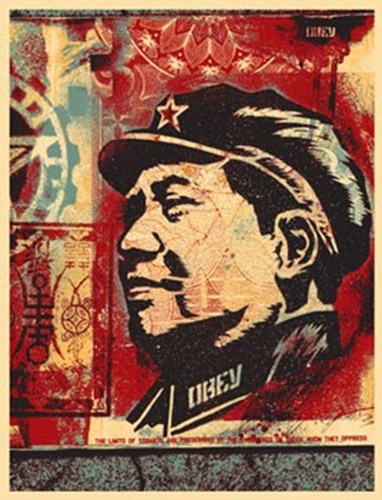
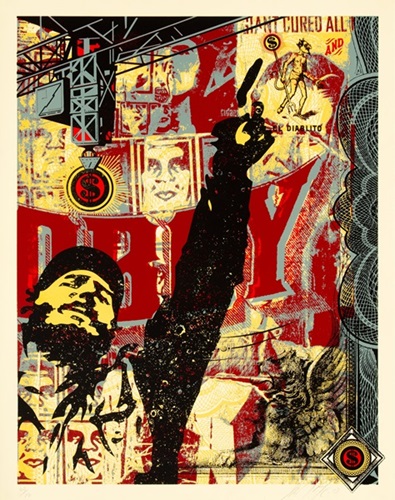
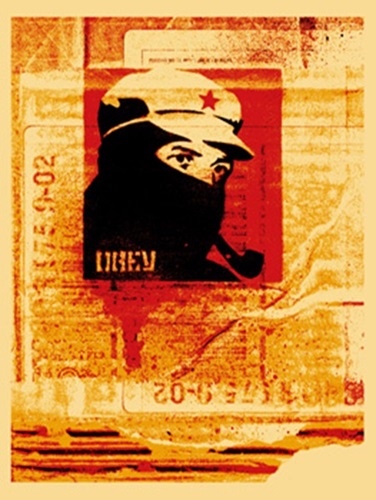
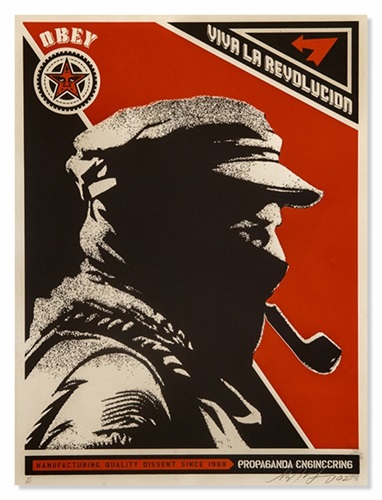
It belongs to a cluster of revolutionary-figure collages from 2003, sitting beside Mao Collage and Castro Collage of the same scale. A companion Marcos Stencil from the same year treats the subject differently, and earlier Marcos Profile work establishes the recurring portrait.
What makes the collage style distinctive?
The work layers texture, pattern, and Fairey's propaganda vocabulary beneath the portrait, elevating it above a flat poster. This collage technique signals fine-art ambition and remained central to his practice in later years.
Related Works
About the Artist

Shepard Fairey (b. 1970, Charleston, South Carolina) is an American street artist, graphic designer, and activist, and a graduate of the Rhode Island School of Design. His 1989 “André the Giant Has a Posse” sticker grew into the global OBEY GIANT campaign — an ongoing experiment in propaganda, obedience, and visual culture. He reached worldwide recognition with the 2008 “Hope” portrait of Barack Obama, now held by the Smithsonian National Portrait Gallery. Across screen prints, stencils, murals, and collage, Fairey channels propaganda aesthetics toward themes of peace, justice, environmentalism, and civil rights. His work is in the collections of the Museum of Modern Art, the Victoria & Albert Museum, and LACMA.