Gauntlet Gallery
What is Shepard Fairey’s piece called “Cop”?
Artist Statement
Screen Print 18 x 24 inches Edition of 100
Summary
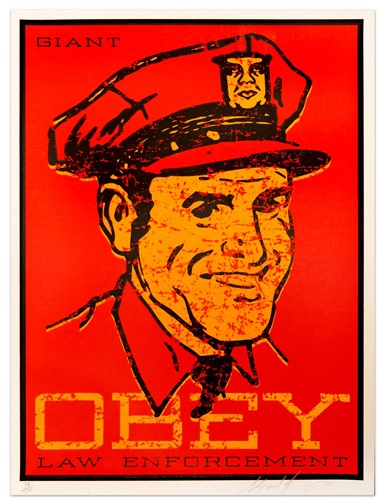
Cop is a 1998 Shepard Fairey screen print published by Obey Giant in a first edition of 100, measuring 18 x 24 inches. The image renders a police figure as a symbol of state authority in Fairey's flat, high-contrast propaganda-poster style. Stripped to bold graphic shapes and a limited palette, the print transforms an everyday emblem of law enforcement into a confrontational icon of control. It belongs to Fairey's late-1990s sequence of editioned screen prints that recast figures and symbols of power through the visual language of mass-produced propaganda, and it serves as the source image for the companion Cop 2.
Why It Matters
Cop is an early example of Fairey using fine-art screen printing to interrogate authority and obedience, the central preoccupation of his Obey Giant project. By presenting a police officer in the same commanding propaganda style he applied to ideological leaders, Fairey foregrounds how symbols of state power are visually constructed and internalized. The 1998 date places it in the foundational period when his street-derived imagery was being formalized into collectible editions of 100. For collectors, Cop matters as a primary statement on surveillance and control within a body of work better known for celebrity portraits and decorative motifs; it represents the harder political edge of his catalog. Its role as the base image behind Cop 2 also gives it documentary value for anyone tracking how Fairey reworked and serialized his motifs. As a low-edition, pre-fame release, it sits among the scarcer early Obey prints and helps anchor a chronological understanding of how Fairey's critique of authority developed before his wider recognition in the 2000s and his 2008 Obama poster.
Collector Perspective
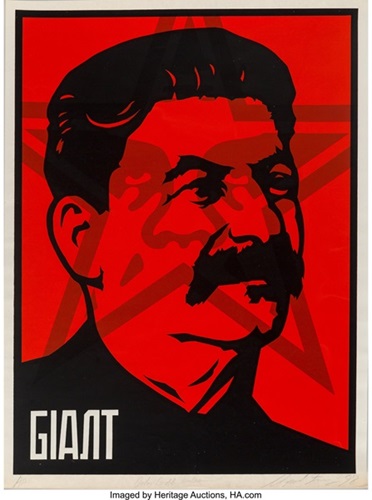
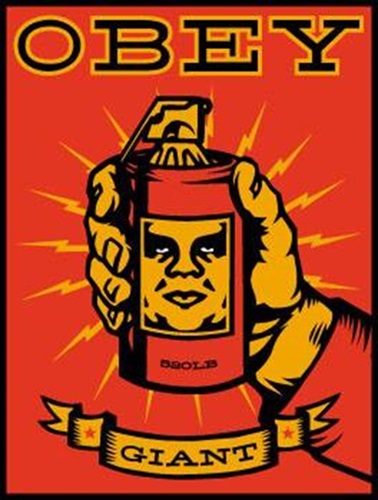
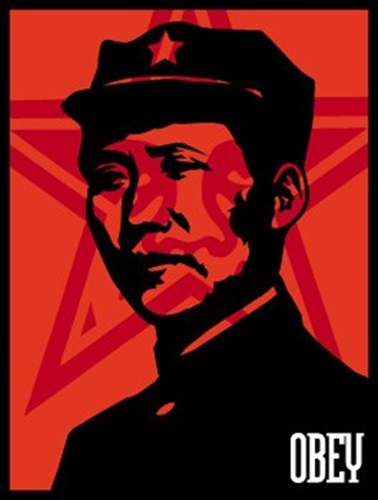
Cop suits collectors building a focused early-Obey holding or a thematic group around authority, control, and surveillance in Fairey's work. The stated first edition of 100 makes it attractive to buyers who prioritize scarcity and a 1998 date that predates Fairey's mainstream fame. It hangs naturally beside its companion Cop 2 and the other 18 x 24 inch 1998 prints such as Stalin, Grenade, and Mao, forming a cohesive period statement. Its bold, confrontational graphic reads strongly on a wall and appeals to those who favor Fairey's political imagery over his floral or music output. The uniform format across the 1998 cohort makes it easy to display as a matched set.
Historical Context
Cop was produced in 1998 as Fairey was consolidating the Obey Giant project that had grown from his 1989 Andre the Giant sticker campaign. In this period he issued a run of 18 x 24 inch screen prints in editions of 100 appropriating politically and ideologically charged imagery. A police figure fits his early focus on how authority manufactures and projects its image, and how viewers obey or resist such symbols. These editions predate his broad fame and his 2008 Hope poster, placing Cop in the foundational Posters and Propaganda phase of his arc, when the propaganda-inspired aesthetic central to his later career was being codified into repeatable, collectible prints.
FAQ
What does Cop depict?
Cop is a 1998 Obey Giant screen print depicting a police figure as a symbol of state authority, rendered in Shepard Fairey's flat, high-contrast propaganda style. It treats an everyday emblem of law enforcement as a confrontational icon of control.
What are the print's dimensions and edition size?
The source record lists the print at 18 x 24 inches in a first edition of 100, published by Obey Giant in 1998 as a screen print.
How is Cop related to Cop 2?
Cop is the earlier image, and Cop 2 is a companion that reworks the same police subject. Both date to 1998, share the 18 x 24 inch format, and were issued in first editions of 100, making them natural pairings in a collection.
Where does Cop fit in Fairey's career?
It belongs to his late-1990s Obey Giant editions, a foundational period when his street-derived imagery was formalized into screen prints of 100. These works predate his wider fame and his 2008 Obama Hope poster.
Related Works
About the Artist

Shepard Fairey (b. 1970, Charleston, South Carolina) is an American street artist, graphic designer, and activist, and a graduate of the Rhode Island School of Design. His 1989 “André the Giant Has a Posse” sticker grew into the global OBEY GIANT campaign — an ongoing experiment in propaganda, obedience, and visual culture. He reached worldwide recognition with the 2008 “Hope” portrait of Barack Obama, now held by the Smithsonian National Portrait Gallery. Across screen prints, stencils, murals, and collage, Fairey channels propaganda aesthetics toward themes of peace, justice, environmentalism, and civil rights. His work is in the collections of the Museum of Modern Art, the Victoria & Albert Museum, and LACMA.