Gauntlet Gallery
What is Shepard Fairey’s piece called “Tokyo Show (First Edition)”?
Artist Statement
Screen Print 18 x 24 inches Edition of 150
Summary
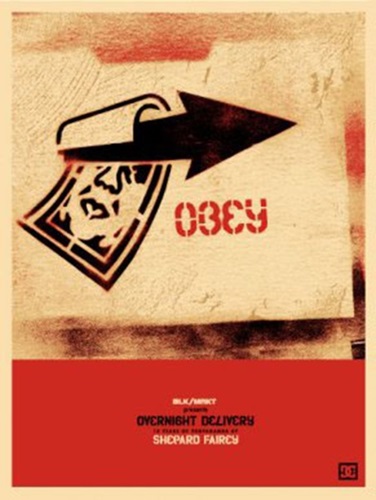
Tokyo Show (First Edition) is a 2000 screen print by Shepard Fairey, published by Obey Giant in a first edition of 150 at 18 x 24 inches, with a listed original price of $30. The title points to a Tokyo exhibition, tying the work to Fairey's early international showing activity. The supplied record gives only catalog facts and no description of the imagery, so visual interpretation is held cautiously. As a small-edition early-era screen print, it documents Fairey's expanding exhibition presence in Japan around 2000.
Why It Matters
Tokyo Show captures a specific moment in Fairey's early internationalization, when his work was being exhibited in Japan, a market that, by his own accounts elsewhere, was an important early supporter of his art. As an exhibition-related print from 2000 with a tight first edition of 150, it functions as both an artwork and a documentary artifact of his growing presence abroad during the formative Obey Giant years. The record's original price of $30 reflects the modest release economics of the period and adds a concrete provenance detail. Classified under collaborations and pop culture, it sits alongside the cluster of 2000-era Obey Giant releases that established Fairey's print catalog. For collectors, exhibition and show posters carry added narrative weight because they pin a work to a place and event, making Tokyo Show a meaningful node connecting Fairey's studio output to his international exhibition history. Because the source omits a description of the actual imagery, claims about its specific visual content are kept cautious; what is firmly supported is its identity as a small-edition, dated, exhibition-linked screen print from the early OBEY period, valuable for anyone tracing the geography and chronology of Fairey's early career.
Collector Perspective
This print appeals to collectors who value exhibition and show-related works for their documentary provenance, as well as completists assembling Fairey's early-2000s catalog. The first edition of 150 is comparatively small, and the documented $30 original price is a useful historical detail. At 18 x 24 inches it is an accessible, frame-friendly size that pairs well with other 2000-era Obey Giant prints in a chronological or event-based display. Its tie to a Tokyo exhibition gives it added appeal to collectors interested in Fairey's international reach. Because the imagery is not described in the source, buyers should confirm visual details directly before purchasing.
Historical Context
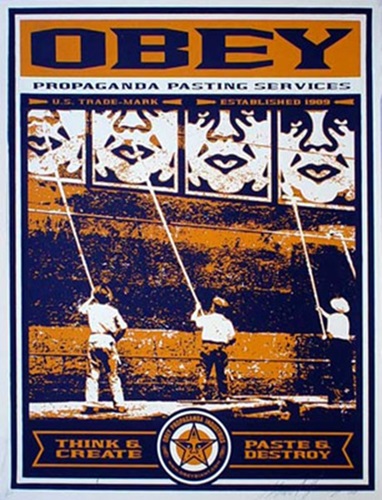
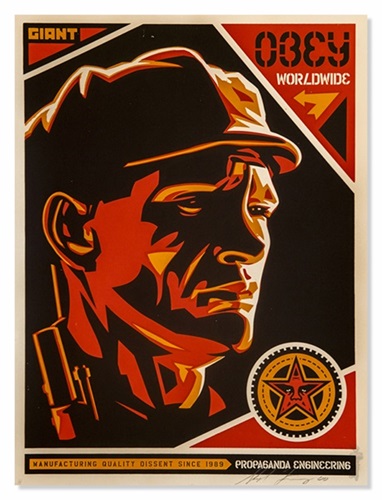
Dated 2000, Tokyo Show belongs to the early Obey Giant studio period and reflects Fairey's expanding exhibition activity in Japan, an early international foothold for his work. Tied by its title to a Tokyo show, it documents the geographic widening of his practice during the formative years following his late-1980s street campaigns. It sits among the cluster of 2000 Obey Giant screen prints that established his print catalog and shared the publisher, medium, and small-edition format of contemporaries like Old School Pasters and Worker. As an exhibition-linked work, it anchors a specific moment in the early arc of his career's international growth.
FAQ
What does the title Tokyo Show refer to?
The title points to a Tokyo exhibition, tying the print to Fairey's early showing activity in Japan around 2000. Exhibition-related prints like this carry added documentary value because they connect the artwork to a specific place and event in his career.
What are the edition size and dimensions?
It is a screen print produced in a first edition of 150, measuring 18 x 24 inches. The small run places it among the more limited early-era Fairey releases, and the standard size makes it easy to frame and display.
What was its original price?
The record lists an original price of $30, reflecting the modest release economics of Obey Giant in 2000. This is a provenance detail only and does not indicate any current or resale value.
Is the imagery described in the record?
No. The supplied source provides only catalog facts, with no narrative description of the visual content. Interpretive claims are therefore kept cautious, and prospective buyers should verify the actual imagery directly before purchase.
Related Works

About the Artist

Shepard Fairey (b. 1970, Charleston, South Carolina) is an American street artist, graphic designer, and activist, and a graduate of the Rhode Island School of Design. His 1989 “André the Giant Has a Posse” sticker grew into the global OBEY GIANT campaign — an ongoing experiment in propaganda, obedience, and visual culture. He reached worldwide recognition with the 2008 “Hope” portrait of Barack Obama, now held by the Smithsonian National Portrait Gallery. Across screen prints, stencils, murals, and collage, Fairey channels propaganda aesthetics toward themes of peace, justice, environmentalism, and civil rights. His work is in the collections of the Museum of Modern Art, the Victoria & Albert Museum, and LACMA.