Gauntlet Gallery
What is Shepard Fairey’s piece called “American Civics - Mass Incarceration”?
Artist Statement
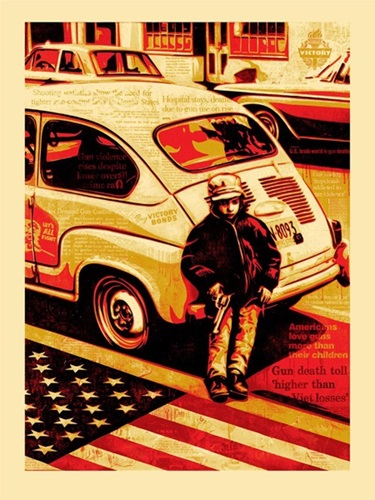
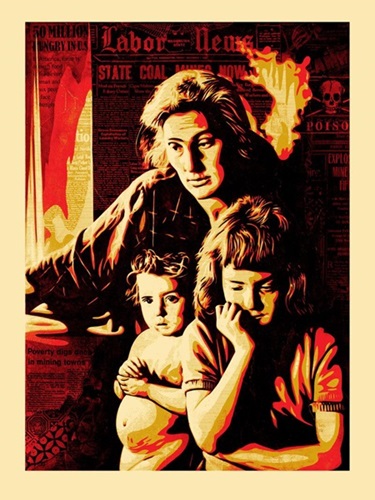
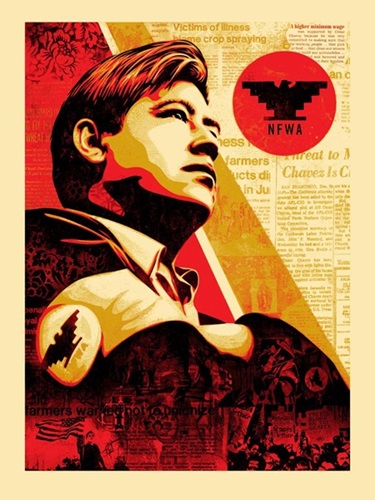
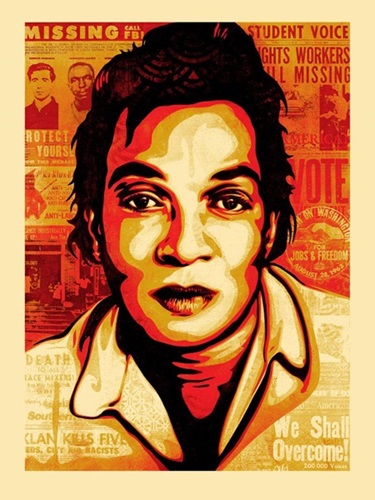
The first-ever collaboration between Shepard and the estate of legendary photographer Jim Marshall, American Civics, debuts this month! Shepard is interpreting Marshall's iconic photography from the 1960's, including images of Johnny Cash, Cesar Chavez, and Fannie Lee Chaney, with five new works, vividly depicting the humanity behind some of the country's enduring social issues: Voting Rights, Mass Incarceration, Worker's Rights, Gun Culture, and Two Americas. "In the past, I was doing Johnny Cash images for art or commercial products. In this case, Johnny Cash has a different use. It's a gateway. If you look at the images woven into the image, there's Martin Luther King's mug shot. There's the prisoner's bill of rights in the corner. There's some references to 'Public Enemy' that were [in] headlines back in Al Capone's time. But for me, it also references the [hip-hop] group Public Enemy, which has a song, 'Black Steel in the Hour of Chaos,' which is about a prison break."
Summary
Mass Incarceration is a 2016 screen print from Shepard Fairey's American Civics series, his first collaboration with the estate of photographer Jim Marshall. Using a Johnny Cash image as a gateway, Fairey weaves in Martin Luther King's mug shot, the prisoner's bill of rights, and Public Enemy references, both the Prohibition-era headline phrase and the hip-hop group whose song addresses a prison break. Published by San Francisco Art Exchange in a first edition of 100, the print measures 40 x 30 inches. One of five works on enduring social issues, it layers cultural references to interrogate the American carceral system.
Why It Matters
Mass Incarceration showcases Fairey's dense, reference-layered approach within American Civics, his first collaboration with the Jim Marshall photography estate. Rather than using Johnny Cash for art or commercial product as before, Fairey repurposes him as a gateway into the carceral theme, embedding Martin Luther King's mug shot, the prisoner's bill of rights, and a double-meaning Public Enemy reference spanning Al Capone-era headlines and the hip-hop group's prison-break anthem. This intertextual density gives the print unusual interpretive depth among Fairey's works and rewards close looking. For collectors, the engagement with mass incarceration, a defining contemporary justice issue, alongside MLK and music history, positions it as one of the series' most conceptually rich images. Its first edition of 100, 40 x 30 inch format, and San Francisco Art Exchange publication mark it as a lower-run, fine-art-format screen print. As part of a cohesive five-work set released in a 2016 election year, it exemplifies Fairey's mid-2010s fusion of pop-culture iconography with pointed social-justice critique.
Collector Perspective
Mass Incarceration appeals to collectors who appreciate layered, reference-rich imagery and the intersection of music, civil rights, and justice. The embedded MLK mug shot, prisoner's bill of rights, and Public Enemy nods make it a rewarding piece for buyers who enjoy decoding visual content. The Johnny Cash gateway also draws music-oriented collectors. At 40 x 30 inches it anchors a wall as a substantial screen print, and completists of the American Civics set treat it as essential. Its small first edition of 100 and SFAE pedigree appeal to those prioritizing scarcity, and it fits naturally into collections themed around social justice, civil rights, or music-crossover activism.
Historical Context
Mass Incarceration belongs to Fairey's mid-2010s engagement with documented American social issues through collaboration. Debuting in May 2016, the American Civics series was his first project with the estate of photographer Jim Marshall, interpreting Marshall's 1960s photography to address voting rights, mass incarceration, workers' rights, gun culture, and two Americas. The print reflects Fairey's long-running interest in music as a vehicle for political meaning, here repurposing Johnny Cash and referencing Public Enemy, while connecting to civil-rights history via Martin Luther King's mug shot. Published by San Francisco Art Exchange in an election year, it extends Fairey's evolving practice of layering pop-culture and historical references into socially engaged fine-art screen prints.
FAQ
What does Mass Incarceration depict?
Fairey uses a Johnny Cash image as a gateway into the carceral theme, weaving in Martin Luther King's mug shot, the prisoner's bill of rights, and references to Public Enemy, both the Prohibition-era headline phrase and the hip-hop group whose song addresses a prison break.
How is Johnny Cash used differently here?
Fairey notes that in the past he used Johnny Cash images for art or commercial products, but in this case Cash serves a different purpose as a gateway into the broader narrative about mass incarceration and the references layered within the image.
What edition and size is the print?
It is a first edition of 100 published by San Francisco Art Exchange. The screen print measures 40 inches high by 30 inches wide, among the larger-format, lower-run works in Fairey's catalog.
What is the American Civics series?
American Civics is Fairey's first collaboration with the Jim Marshall estate, a five-work set interpreting Marshall's 1960s photography to address voting rights, mass incarceration, workers' rights, gun culture, and two Americas.
Related Works
About the Artist
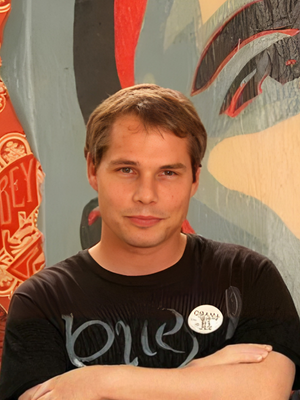
Shepard Fairey (b. 1970, Charleston, South Carolina) is an American street artist, graphic designer, and activist, and a graduate of the Rhode Island School of Design. His 1989 “André the Giant Has a Posse” sticker grew into the global OBEY GIANT campaign — an ongoing experiment in propaganda, obedience, and visual culture. He reached worldwide recognition with the 2008 “Hope” portrait of Barack Obama, now held by the Smithsonian National Portrait Gallery. Across screen prints, stencils, murals, and collage, Fairey channels propaganda aesthetics toward themes of peace, justice, environmentalism, and civil rights. His work is in the collections of the Museum of Modern Art, the Victoria & Albert Museum, and LACMA.