Gauntlet Gallery
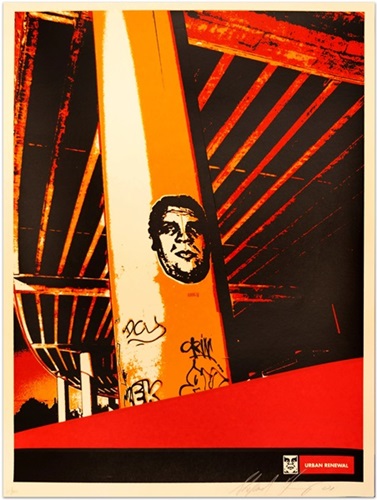
What is Shepard Fairey’s piece called “Chinese Stencil”?
Artist Statement
CHINESE STENCIL Screen Print 18 x 24 inches Edition of 200
Summary
Chinese Stencil is a 2000 Shepard Fairey screen print, published by Obey Giant in a first edition of 200, measuring 18 x 24 inches. Executed in Fairey's stencil-driven, high-contrast graphic style, it references Chinese imagery and belongs to his early Obey Giant studio output. As a run of 200 impressions, it sits among the moderately limited editions of the period. The work reflects Fairey's recurring interest in appropriating global and East Asian visual motifs, a thread that runs through several of his turn-of-the-millennium stencils.
Why It Matters
Chinese Stencil sits within a cluster of Shepard Fairey's 2000 stencil works that draw on international and East Asian imagery, a recurring interest in his early Obey Giant period. Dated 2000 and published in a first edition of 200, it documents the stencil-driven technique and propaganda-style aesthetic that defined Fairey's studio practice as it grew out of street art. The Chinese subject connects to a broader strand in his catalog—works that appropriate Communist-era and East Asian visual codes to build his distinctive graphic language. For a knowledge-graph audience, the print's value is documentary and relational: it anchors a node among the year's companion stencils and links to earlier and later works on related themes, such as his 1997 Chinese Soldier and 2001 Chinese Building. Collectors who track the chronology and thematic threads of Fairey's output value this period for showing how he assembled his visual vocabulary before his mainstream breakthrough. Its edition of 200 is modest, balancing scarcity with availability. As an early stencil rooted in appropriated iconography, Chinese Stencil represents the experimental, technique-forward side of Fairey's practice and helps map his sustained engagement with propaganda imagery across decades.
Collector Perspective
Chinese Stencil appeals to Fairey collectors focused on his early stencil-era output and to those drawn to his appropriation of propaganda and East Asian motifs. The edition of 200 is accessible while still limited, and the 18 x 24-inch format frames easily and groups naturally with companion 2000 stencils. Its bold, high-contrast graphic reads strongly on a wall. The print suits a collector building a thematic set around Fairey's Chinese and propaganda-inspired imagery—linking it to related earlier and later works—or assembling a chronological survey of his pre-Obama studio practice, where technique and appropriated iconography matter more than celebrity subject matter.
Historical Context
Chinese Stencil belongs to Shepard Fairey's early Obey Giant studio period around 2000, when his street-rooted stencil practice was becoming editioned studio work. Its Chinese subject fits a recurring engagement with Communist-era and East Asian visual codes that appears across his catalog, from the 1997 Chinese Soldier to the 2001 Chinese Building. This appropriation of propaganda imagery was central to how Fairey constructed his graphic identity well before his 2008 Obama image. The print sits within the dense group of 2000 Obey Giant stencils, documenting an experimental, technique-focused phase that laid the groundwork for his later, more overtly political work.
FAQ
What does Chinese Stencil depict?
As the title indicates, the print references Chinese imagery, executed in Fairey's stencil-driven graphic style. It fits a recurring interest in East Asian and Communist-era visual codes seen across several of his works.
When was it made and how large is the edition?
Chinese Stencil is dated 2000, published by Obey Giant, in a first edition of 200 impressions per the source. That is a modest run for the period, balancing scarcity with availability.
What are the dimensions and medium?
It is a screen print measuring 18 x 24 inches, according to the source description, a frame-friendly format common to Fairey's editioned prints of the era.
How does it relate to his other work?
It connects to a thread of Chinese-subject pieces in Fairey's catalog, including the 1997 Chinese Soldier and the 2001 Chinese Building, reflecting his sustained use of propaganda-style appropriation.
Related Works
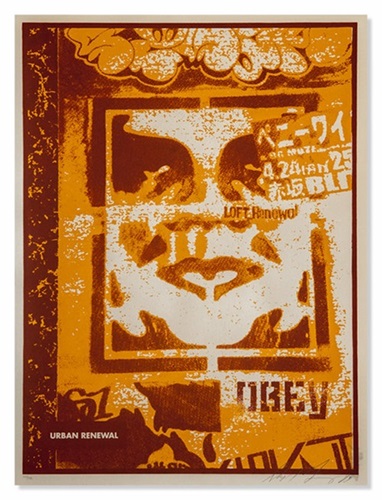

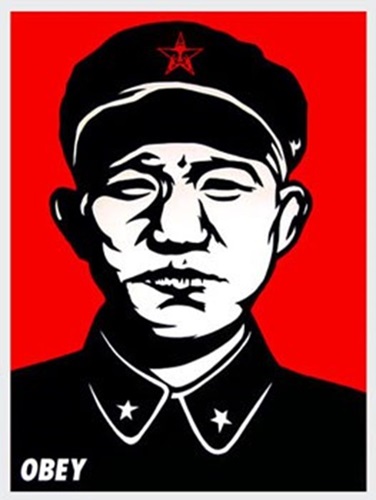
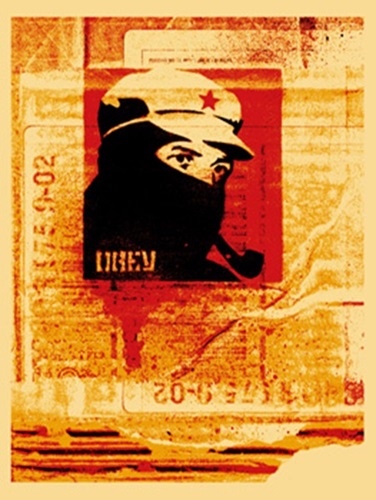
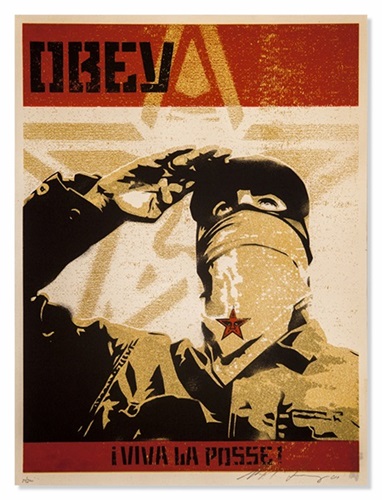
About the Artist

Shepard Fairey (b. 1970, Charleston, South Carolina) is an American street artist, graphic designer, and activist, and a graduate of the Rhode Island School of Design. His 1989 “André the Giant Has a Posse” sticker grew into the global OBEY GIANT campaign — an ongoing experiment in propaganda, obedience, and visual culture. He reached worldwide recognition with the 2008 “Hope” portrait of Barack Obama, now held by the Smithsonian National Portrait Gallery. Across screen prints, stencils, murals, and collage, Fairey channels propaganda aesthetics toward themes of peace, justice, environmentalism, and civil rights. His work is in the collections of the Museum of Modern Art, the Victoria & Albert Museum, and LACMA.