Gauntlet Gallery
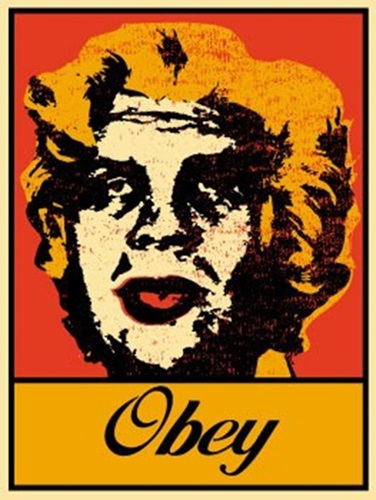
What is Shepard Fairey’s piece called “Andre Warhol”?
Artist Statement
In 1995, most people probably couldn't imagine Andre the Giant as a pop art icon (and many said so), but I thought I could bring some humor and imagination to that pop art notion as well as a tribute to one of my art heroes, Andy Warhol. Don't let the fear of seeming weird stifle your imagination! - Shepard ????????? Shepard Fairey Andre Warhol, 1995 Screenprint 17 x 25 inches
Summary
Andre Warhol is a 1995 screen print published by Obey Giant in a first edition of 60, measuring 17 by 25 inches. In Fairey's own words it reimagines Andre the Giant as a pop-art icon and pays tribute to Andy Warhol, one of his art heroes. The piece deliberately fuses the OBEY Giant face with Warhol's silkscreen-celebrity vocabulary, turning the wrestler into a Warholian subject. Fairey frames it as an exercise in humor and imagination, encouraging viewers not to let fear of seeming weird stifle creativity. The very small edition of 60 and the explicit artist statement make this one of the more documented and personal works from his mid-1990s output.
Why It Matters
Andre Warhol is unusually well-documented for an early Fairey print because the source carries his own statement about it. That makes it a clear window into how Fairey was thinking in 1995: explicitly positioning the Andre the Giant face as pop art and tying his street project to Andy Warhol's silkscreen-celebrity tradition. The conceptual move matters because Warhol's strategy of turning famous faces into repeatable icons is exactly the logic Fairey applied to the Giant, and here he names the lineage outright. For collectors, the appeal is layered: it is an early first edition with a tiny run of 60, it is a self-aware homage to a canonical artist, and it documents Fairey reflecting on his own method while it was still forming. His closing line about not letting the fear of seeming weird stifle imagination gives the piece a personal, almost manifesto-like quality rare in his catalog. The Warhol reference also makes it a natural bridge between street art and the broader pop-art canon, appealing to buyers who collect across both. Within his mid-1990s body of work it stands out as one of the most intentional statements about influence and appropriation, rather than a purely graphic exercise.
Collector Perspective
Andre Warhol attracts collectors who care about artist intent and art-historical lineage, not just the OBEY brand. The documented Fairey statement and the explicit Warhol homage give it depth that appeals to buyers who like a print with a story. With a first edition of just 60, it is one of the scarcer early pieces and a strong anchor for a focused mid-1990s grouping. The pop-art crossover broadens its audience to collectors of Warhol-adjacent and silkscreen-celebrity work. On a wall it reads as a knowing, witty portrait, rewarding viewers who recognize the Warhol reference and the in-joke of elevating a wrestler to fine-art icon.
Historical Context
Dated 1995, Andre Warhol comes from the formative mid-1990s phase when Shepard Fairey was actively defining what the Andre the Giant image could mean. The accompanying statement shows him consciously aligning his project with Andy Warhol's pop-art method of turning faces into icons, a self-aware gesture that predates his later red-and-cream propaganda style and his political work. It sits among his earliest first editions, close in time to the other Giant and Beatles prints of this period. Within his arc it marks an important conceptual moment: rather than simply deploying the icon, Fairey reflects on the appropriation strategy itself and credits the lineage. This makes it a key early reference point for understanding how his street campaign matured into a deliberate fine-art practice.
FAQ
What is Andre Warhol about?
Per Fairey's own statement in the source, it reimagines Andre the Giant as a pop-art icon and serves as a tribute to Andy Warhol, one of his art heroes. He frames it as bringing humor and imagination to that pop-art notion, and encourages viewers not to let the fear of seeming weird stifle their creativity.
How rare is this print?
The source lists it as a first edition of 60, a very small run that places it among the scarcer early Fairey editions. The source does not state that it is sold out, so availability beyond the edition size is not claimed here.
What are its dimensions and medium?
It is a screen print measuring 17 by 25 inches, dated 1995 and published by Obey Giant. The size makes it a substantial early piece relative to some of Fairey's smaller mid-1990s prints.
Why does the Warhol connection matter?
Warhol turned famous faces into repeatable silkscreen icons, the same logic Fairey applied to the Andre the Giant image. Here Fairey names that lineage directly, making the print an unusually self-aware statement about appropriation and influence within his early catalog.
Related Works
About the Artist
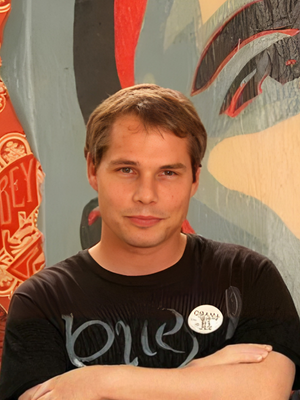
Shepard Fairey (b. 1970, Charleston, South Carolina) is an American street artist, graphic designer, and activist, and a graduate of the Rhode Island School of Design. His 1989 “André the Giant Has a Posse” sticker grew into the global OBEY GIANT campaign — an ongoing experiment in propaganda, obedience, and visual culture. He reached worldwide recognition with the 2008 “Hope” portrait of Barack Obama, now held by the Smithsonian National Portrait Gallery. Across screen prints, stencils, murals, and collage, Fairey channels propaganda aesthetics toward themes of peace, justice, environmentalism, and civil rights. His work is in the collections of the Museum of Modern Art, the Victoria & Albert Museum, and LACMA.